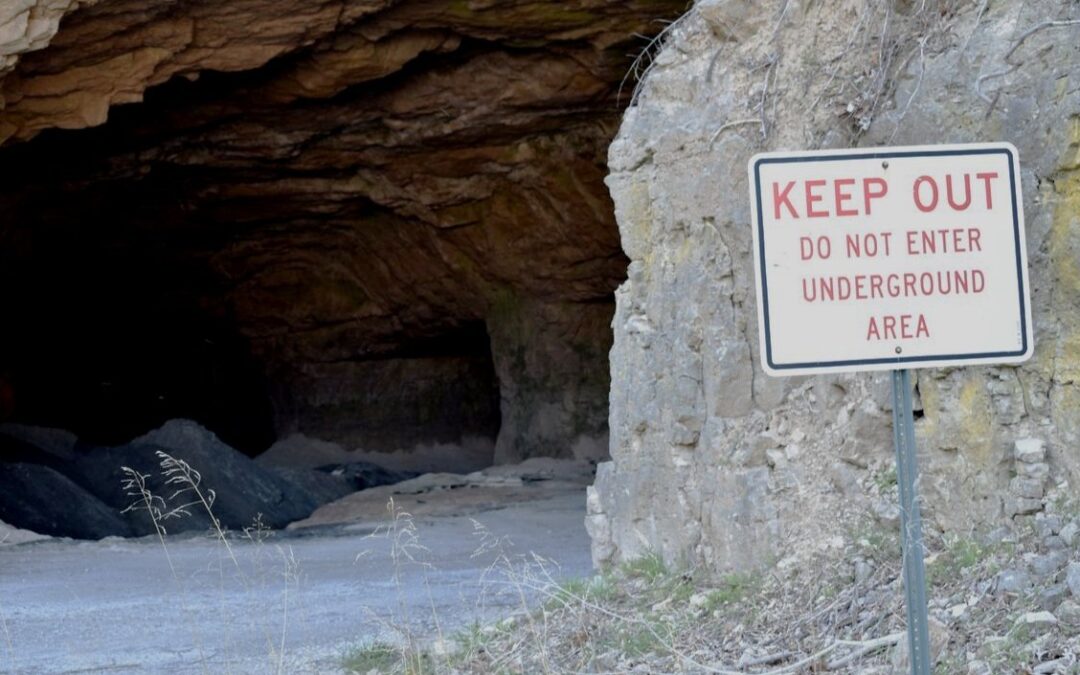
If you have recently received an Abandoned Mine Lands (AML) hazard notice, you may be wondering exactly what AML hazard fencing is and why it is important.
Until recently, prospectors were allowed to leave a mine site without being required to leave the property in a safe condition. These aging abandoned mines may contain sheer drop-offs, unstable earth, abandoned equipment, trapped gasses, deep standing water, and more. With no posted warning signs or barriers required, abandoned mines became a hazard across the country. Each year, individuals in the United States are injured or killed in these mining hazards due to falls, entrapment, drowning, and more. To help prevent accidents, owners of abandoned mine land are required to erect and maintain AML hazard notices and barricades.
To aid in this safety effort, several state and federal organizations identify and monitor abandoned land mines. Landowners are asked to proactively manage AML hazard fencing around known abandoned mine lands, even if they have not received a notice, to help protect the public.
WHAT IS AML HAZARD FENCING?
AML hazard fencing refers to posted signage, barricades, and/or fences erected around abandoned mine land areas and access points. These barricades and signs are intended to help protect individuals from undue access and injury.
For ordered AML Hazard fencing required by a state or federal program, there are minimal requirements for these signs and barricades that must be followed depending on access point type and hazard level. Individuals receiving an AML Hazard Notice will be provided a certain amount of time (typically between 60-180 days, depending on the hazard level) to erect this fencing and send proof of completion. In addition, landowners are required to maintain these notices and barricades to ensure safety.
COMMON ABANDONED MINE LAND HAZARDS
What’s so dangerous about abandoned mine land hazards? When mines are constructed, they have safety precautions in place that are intended only for the short term. When these mines were abandoned, vertical openings were often left uncovered, support structures were removed or left to rot, and safety systems such as ventilation and water-pumping equipment were removed.
There are several types of hazards that may be present at an abandoned mine site depending on the size, scope, equipment, and location of the mine.
- Adits, Declines, and Shafts. Open adits and shafts are the most common type of hazard in the Western United States. Adits tunnel into the ground horizontally, declines tunnel in at an angle, and shafts tunnel down vertically. These diggings can be unstable and there may not be much indication the hazard is there until someone is very close to it.
- Trenches and Pits. Trenches and Pits are common in historical mining districts. Many times the walls are unstable; these areas need to be fenced to keep people out and warn people that a hazard is in the area.
- Water Hazards. The largest cause of death in abandoned mines in the United States is water. Many abandoned mines become flooded, leaving water that may be dangerously deep and cold, as well as having slippery walls, steep drop-offs, and other hazards.
- Gasses & Oxygen Deficiency. Mines are also at risk of accumulating pockets of deadly gasses such as carbon monoxide, methane, or even pockets of still air that have little oxygen concentration.
- Cave-Ins. Even active mines are at risk of cave-ins, but for abandoned mines, this risk increases. Over time, bedrock can become increasingly unstable due to weathering, blasting, water accumulation, and other factors. This makes even casual exploration dangerous in or around an abandoned mine.
- Highwalls. Underground mines are not the only AML areas that contain risks. Open pits and quarries also contain risks. Highwalls are vertical or near-vertical edges of these pits or quarries. These areas can be prone to collapse, which makes them dangerous to climb on or near.
AML HAZARD FENCING SERVICES
If you’d like to learn more about AML hazard fencing requirements or services, please reach out to Rangefront’s mining services experts today.

ABOUT THE AUTHOR
BRIAN GOSS
President, Rangefront Mining Services
Brian Goss brings over 20 years of experience in gold and mineral exploration. He is the founder and President of Rangefront, a premier geological services and mining consulting company that caters to a large spectrum of clients in the mining and minerals exploration industries. Brian is also a director of Lithium Corp. (OTCQB: LTUM), an exploration stage company specializing in energy storage minerals and from 2014 to 2017, he fulfilled the role of President and Director of Graphite Corp. (OTCQB: GRPH), an exploration stage that specialized in the development of graphite properties. Prior to founding Rangefront, Brian worked as a staff geologist for Centerra Gold on the REN project, as well as various exploration and development projects in the Western United States and Michigan. Brian Goss holds a Bachelor of Science Degree with a major in Geology from Wayne State University in Michigan.
You may also be interested in...

Magnetic Surveys in Mineral Exploration: How They Work, What They Show, and Why They Matter
Magnetic surveys, commonly known as mag surveys, are one of the most valuable and widely used geophysical tools in mineral exploration. They provide rapid, cost-effective insight into subsurface geology by measuring variations in the Earth’s magnetic field. These...

The 2026 Mining Career Handbook: Roles, Salaries, and How to Build a Future in a Changing Industry
The mining industry has entered a defining decade. As the world transitions toward clean energy and critical mineral demand surges, career opportunities in mining are expanding across every level from field crew operators to geoscientists, engineers, and project...

Free GPR Feasibility Checklist: Is Your Site Suitable for Ground-Penetrating Radar Scanning?
Ground-Penetrating Radar (GPR) is a powerful, non-invasive subsurface imaging tool that plays a critical role in industries ranging from construction and environmental consulting to archaeology and mineral exploration. In mineral exploration and mining, GPR can help...

Mining in British Columbia: Opportunities and Challenges
British Columbia (BC) is one of the world’s most geologically rich and mining-friendly regions. Known for its vast mineral wealth and complex terrain, BC is home to some of Canada’s most productive mining operations. This article explores mining in British Columbia,...

Canada’s Critical Mineral Corridors: What’s Next for Lithium, Cobalt & Rare Earths?
As global industries shift toward decarbonization and clean energy, critical minerals have become the new currency of innovation. From electric vehicles (EVs) to wind turbines and advanced electronics, minerals like lithium, cobalt, and rare earth elements (REEs) are...

Environmental Considerations in Canadian Mining: Best Practices
Mining has long been an integral part of Canada’s economy, providing essential minerals and metals that fuel global industries—from construction and energy to technology and transportation. However, mining also presents environmental challenges, including habitat...

Soil Sampling Techniques Used in Mineral Exploration
Soil sampling plays a crucial role in modern mineral exploration. When properly executed, it provides vital geochemical data that helps geologists and exploration companies assess the mineral potential of a target area with greater precision. Various techniques are...

Indigenous Partnerships in Canadian Geophysics: Best Practices for Ethical Exploration
Across Canada, mineral exploration is moving toward greater transparency, accountability, and reconciliation with Indigenous Peoples. As outlined in the Mining Association of Canada’s Towards Sustainable Mining (TSM) protocols, ethical exploration now requires early,...

The Role of Geochemical Soil Sampling in Discovering Ore Deposits
In the evolving landscape of mineral exploration, geochemical soil sampling continues to become increasingly important. As the global demand for critical minerals surges, mining companies and geological services providers are turning to advanced geochemical techniques...

The Future of Mineral Exploration in Canada’s Northern Territories
Canada’s Northern Territories, Yukon, Northwest Territories, and Nunavut, are becoming an important focus point in mineral exploration. These regions contain significant deposits of critical and strategic minerals that are in growing demand globally due to their role...

Highest Paying Jobs in the Mining Industry (2025 Update)
The mining industry in the United States is a vital sector of the economy, supporting infrastructure, technology, clean energy, and more. It encompasses a wide range of activities, from the extraction of coal and base metals to high-demand minerals like lithium,...

How to Stake a Mining Claim in 2025: A Step-by-Step Guide
The process of staking a mining claim dates back to 1849 during the California Gold Rush, when miners adopted their own rules to establish rights to mine land in the absence of formal regulations. The legal foundation was based on the principle of prior...