
In the evolving landscape of mineral exploration, geochemical soil sampling continues to become increasingly important. As the global demand for critical minerals surges, mining companies and geological services providers are turning to advanced geochemical techniques to improve accuracy, cost-efficiency, and success rates.
This article explores the strategic importance of geochemical soil sampling in ore discovery, how it works, modern techniques used, and how the data influences exploration decisions. We also examine the integration of soil geochemistry with other geological methods to refine targeting in both greenfield and brownfield exploration projects.
Quick Links:
What is Geochemical Soil Sampling
Why Soil Geochemistry is Crucial in Ore Discovery
Soil Sampling Strategies and Techniques
Interpreting Soil Sampling Data
Case Studies in Geochemical Success
Challenges and Limitations of Soil Sampling
Emerging Technologies in Soil Geochemistry
What Is Geochemical Soil Sampling?
Geochemical soil sampling is a systematic process of collecting soil at specific depths and intervals across an area to analyze its mineralization. By detecting geochemical anomalies, exploration teams can identify potential mineral targets buried beneath the surface.
This method is particularly effective in terrains where bedrock is obscured by cover, such as colluvium, glacial till, regolith, or vegetation. The geochemical signature in the overlying soils often reflects the composition of underlying rocks and potential ore bodies due to the vertical and lateral movement of trace elements.
Why Soil Geochemistry Is Crucial in Ore Discovery
Soil geochemistry provides a cost-effective, non-invasive, and data-rich approach to prioritizing drill targets and reducing exploration risk. Some of the top benefits of geochemical soil sampling include:
1. Early-Stage Targeting
In greenfield exploration where geological outcrops are minimal, soil geochemistry can rapidly narrow down areas of interest. A high-resolution soil sampling grid can detect low-level geochemical anomalies that wouldn’t be visible through mapping or geophysics alone.
2. Detection Under Cover
Modern geochemical techniques can detect mineralization hidden beneath sedimentary basins, overburden, or vegetation. This capability is essential in previously-mined areas where shallow resources are already exploited, and new discoveries depend on finding deposits under cover.
3. Environmental Sensitivity
Unlike trenching or drilling, soil sampling is minimally invasive and can be conducted with very little environmental disturbance, making it suitable for exploration in environmentally sensitive or protected areas.
4. Integration with Other Data
Soil geochemistry integrates seamlessly with geophysical surveys, remote sensing data, structural interpretation, and geological mapping. This multidisciplinary approach refines exploration models and enhances the predictability of subsurface targets.
Soil Sampling Strategies and Techniques
Effective geochemical soil sampling relies on sampling programs designed specifically for the geological setting, target mineralization style, and surface conditions.
Grid Spacing
The resolution of the sampling grid (e.g., 50x50m, 100x100m) depends on the scale of the exploration and expected footprint of the deposit. Detailed grids increase the resolution of geochemical anomalies, particularly in structurally complex terrains.
Sample Depth and Horizon
Soils are typically sampled from specific horizons such as the B-horizon, which is less influenced by organic matter and more likely to contain secondary dispersion of target elements. In arid or glaciated environments, deeper or specialized sampling methods like auger or power-auger drilling may be used to reach optimal horizons.
Analytical Techniques
Geophysical soil samples are analyzed using techniques such as:
- ICP-MS (Inductively Coupled Plasma Mass Spectrometry): High sensitivity for trace elements, essential for detecting pathfinder elements at low concentrations
- XRF (X-ray Fluorescence): Rapid and cost-effective, often used for field screening
- Fire Assay: Gold analysis where very low detection limits are needed
Additionally, mobile metal ion (MMI) analysis and partial leach techniques are increasingly popular for detecting deeply buried mineralization.
Interpreting Soil Sampling Data
Once the soil samples are collected, the data needs to be carefully reviewed and analyzed with both statistics and geology in mind. Here’s how that process works:
1. Background Definition
Geologists first determine the typical (or background) levels of each element in the soil. This information will act as a baseline from which they can identify anomalies, which could point to hidden mineral deposits.
2. Multi-Element Analysis
Rather than relying on a single element (e.g., copper), exploration geochemists use pathfinder element suites associated with different ore deposit types. For example:
- Gold: Often accompanied by arsenic, antimony, bismuth
- VMS (Volcanogenic Massive Sulfide): Zinc, lead, copper, silver
- Porphyry copper: Molybdenum, tungsten, manganese
3. Spatial Analysis and Zoning
Mapping the spatial distribution of anomalies helps identify zoning patterns that reflect hydrothermal systems. For instance, higher concentrations of arsenic and antimony on the outside of a gold deposit can guide vectors toward the ore core.
4. Integration with Structural Controls
Geologists often compare geochemical anomalies with mapped features like faults or folds. These structures can act as pathways for mineral-rich fluids or create spaces where those fluids settle, helping pinpoint where ore deposits might be found.
Case Studies in Geochemical Success
Several world-class ore deposits were discovered through soil geochemistry, such as:
- Olympic Dam (Australia): Geochemical anomalies of copper, uranium, and rare earths were critical in targeting this tier-one IOCG (Iron Oxide Copper Gold) deposit
- Fruta del Norte (Ecuador): Soil geochemistry revealed a robust gold-arsenic-antimony anomaly that led to the discovery of one of the richest undeveloped gold deposits in the Americas
- Kamoa-Kakula (DRC): Soil sampling highlighted elevated copper zones in the Central African Copperbelt, later confirmed by drilling
Challenges and Limitations of Soil Sampling
While soil geochemistry is powerful, it has limitations:
- Post-Depositional Alteration: Weathering, leaching, and biological activity can distort original geochemical signals
- Transported Cover: In areas with thick transported overburden, anomalies may be subtle or displaced
- False Anomalies: Anthropogenic contamination or lithological variability can produce misleading results
Thus, quality assurance, field validation, and multi-disciplinary data integration are essential to avoid misinterpretation.
Emerging Technologies in Soil Geochemistry
Innovation is driving more efficient and accurate soil geochemical programs. Some emerging technologies we expect to see more of include:
- Portable XRF and real-time analysis to reduce turnaround time and enable adaptive sampling strategies in the field
- Machine learning algorithms to assist in multivariate anomaly detection and pattern recognition in large datasets
- Hydrogeochemical and biogeochemical sampling techniques to complement soil sampling, especially in challenging terrains
These technologies are transforming geochemical programs from static sampling grids to dynamic, data-driven exploration strategies.
Final Thoughts: Soil Geochemistry as a Strategic Asset
Geochemical soil sampling offers a blend of scientific precision and practical application in mineral exploration. In a competitive industry where efficiency, accuracy, and sustainability are integral, soil geochemistry helps de-risk exploration investment and improve discovery outcomes.
If you’re planning a mineral exploration project and want expert support with geochemical soil sampling, Rangefront is here to help. From designing effective sampling strategies to interpreting complex data sets, our team brings the technical expertise and field experience needed to help you unearth success.

ABOUT THE AUTHOR
BRIAN GOSS
President, Rangefront Mining Services
Brian Goss brings over 20 years of experience in gold and mineral exploration. He is the founder and President of Rangefront, a premier geological services and mining consulting company that caters to a large spectrum of clients in the mining and minerals exploration industries. Brian is also a director of Lithium Corp. (OTCQB: LTUM), an exploration stage company specializing in energy storage minerals and from 2014 to 2017, he fulfilled the role of President and Director of Graphite Corp. (OTCQB: GRPH), an exploration stage that specialized in the development of graphite properties. Prior to founding Rangefront, Brian worked as a staff geologist for Centerra Gold on the REN project, as well as various exploration and development projects in the Western United States and Michigan. Brian Goss holds a Bachelor of Science Degree with a major in Geology from Wayne State University in Michigan.
You may also be interested in...

Annual Claim Renewals Updated for 2026: Mining Claim Maintenance & Assessment Information
Late summer is a critical time for the mining and exploration industry. The deadline for Annual Mining Claim Renewals is September 1, and it arrives fast. Whether you’re a small-scale prospector or managing dozens of claims, it’s essential to ensure your filings,...
Combining Drone and Ground Mag Surveys: More Data, Less Time in the Field
A magnetic survey is only as good as the data density behind it. Two survey platforms, flown and walked over the same ground on the same program, can double that density without doubling your budget or your schedule. That is the logic behind Rangefront's approach to...
Yukon Geophysical Surveys: Season Planning and Field Logistics
The Yukon exploration season is shorter than most project managers account for, and the margin for a poorly timed mobilization is close to zero. Between spring break-up, permafrost thaw cycles, and the onset of fall freeze, the usable field window for most ground...
How to Read an IP Pseudosection: Interpreting Chargeability and Resistivity Anomalies Before You Drill
A chargeability anomaly that looks like a porphyry target and turns out to be graphitic shale is a wasted drill hole, a budget hit, and a credibility problem in front of your board. Reading an IP pseudosection correctly before the rig mobilizes is one of the...
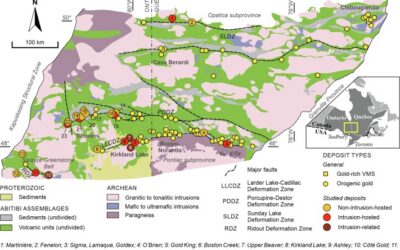
Mineral Exploration in the Abitibi Greenstone Belt: Geology, Deposit Types, and What to Expect in the Field
Image Source: https://www.sciencedirect.com/science/article/abs/pii/S016913682100247X The Abitibi Greenstone Belt produced more gold than almost any other Archean terrane on Earth, and the ground is still generating discovery-stage programs across northern Ontario and...
Beyond the Borehole: How 3D Geotechnical Modeling is De-Risking Modern Mine Design
The difference between a viable project and a costly oversight lies in the "digital twin" of the subsurface. Traditional 2D cross-sections, once the industry standard, are no longer sufficient for the complexities of modern resource extraction and the stringent safety...

Starting a Geology Career in Mining and Mineral Exploration
Graduating with a geology degree opens doors, but it can be hard to know which ones to walk through first. Many new graduates want work that's hands-on, technically meaningful, and connected to real projects, but translating that into an actual job search takes some...

Soil Sampling vs. Magnetic vs. Gravity Surveys in Canada’s Covered Terrain
Canada is home to some of the world’s most promising mineral districts, but many of those opportunities lie beneath cover rather than in clean, exposed outcrops. Across much of the country, exploration teams work in terrain shaped by glaciation, transported...

2026 Regulatory Shifts in Geophysics & Geotechnical Reporting in Canada
For Canadian junior and major exploration firms, the "Qualified Person" (QP) is under more scrutiny than ever. As we move into 2026, the integration of geophysical data into NI 43-101 technical reports has evolved from "supplemental" to "essential." In an era of...
How Geophysical Surveys Support Mineral Exploration in Canada’s Remote and Covered Terrains
Canada is one of the most mineral-rich countries in the world, but much of that potential lies in places that are difficult, expensive, or logistically complex to explore. From vast stretches of the Precambrian Shield to sediment-covered basins and northern regions...

Gravity Surveys in Mineral Exploration: How They Work, What They Reveal, and Why They Matter
In mineral exploration, every decision hinges on understanding what lies beneath the surface before drilling begins. Gravity surveys provide a precise, cost-effective way to map subsurface density variations and uncover geological structures that may host valuable...

Why Magnetic and Gravity Surveys Are Essential for Mineral Exploration in Canada
Canada is one of the most geophysically explored countries in the world. With vast mineral potential spread across the Precambrian Shield, structurally complex greenstone belts, sedimentary basins, and remote northern terrains, Canadian exploration has long relied on...