
Soil sampling plays a crucial role in modern mineral exploration. When properly executed, it provides vital geochemical data that helps geologists and exploration companies assess the mineral potential of a target area with greater precision. Various techniques are employed depending on the terrain, exploration stage, target mineralogy, and geotechnical considerations. This article explores the key soil sampling methods used in mineral exploration, their applications, advantages, and limitations, with a focus on best practices for generating reliable and actionable data.
The Role of Soil Sampling in Mineral Exploration
Types of Soil Sampling Techniques
Soil Sampling Best Practices
Geotechnical Considerations in Soil Sampling
The Role of Soil Sampling in Mineral Exploration
Soil sampling is part of a broader geochemical exploration process designed to detect anomalies—unusual concentrations of elements that may indicate the presence of mineralization below the surface. Because many ore deposits release trace elements that migrate into overlying soils through processes such as leaching, dispersion, and mechanical weathering, analyzing the chemical composition of soil layers can reveal hidden mineral targets for early-stage drilling.
From a geotechnical perspective, understanding the soil stratigraphy, particle distribution, and moisture content further assists in interpreting geochemical results and planning subsequent exploration phases, such as trenching, geophysical surveys, or core drilling.
Types of Soil Sampling Techniques
Soil sampling methods vary based on depth requirements, sample quality, ground conditions, and cost. Below are the most common soil sampling techniques used in mineral exploration.
1. Grid Sampling (Systematic Sampling)
Grid sampling is a widely used soil sampling technique in early-stage exploration, where samples are collected at regular intervals along a predetermined grid pattern, such as 50m x 50m or 100m x 100m.
Application: Ideal for regional geochemical surveys, anomaly delineation, and geostatistical modeling.
Advantages:
- Provides spatially consistent data
- Easy to map anomalies and trends
- Supports interpolation for geochemical contouring
Limitations:
- May miss narrow or irregularly shaped anomalies
- Labor-intensive over large or rugged areas
2. Auger Sampling
Auger sampling is a soil sampling technique that uses a hand or power auger to extract samples from subsurface layers, typically ranging from 0.5 to 3 meters deep, allowing exploration below surface contamination or organic material.
Application: Suitable for areas with deep overburden, transported soils, or lateritic profiles common in tropical regions.
Advantages:
- Access to subsoil layers closer to the geochemical signal
- Can penetrate below false anomalies created by surface activity
Limitations:
- Limited by soil compaction, rocks, and groundwater
- Slower and more equipment-intensive than surface sampling
3. Pit or Trench Sampling
As a more advanced soil sampling technique, pit or trench sampling involves excavating into the soil to expose the profile, allowing detailed sampling of individual soil horizons or continuous vertical sections.
Application: Useful for advanced-stage exploration when high-resolution geochemical profiles are needed.
Advantages:
- Allows visual inspection of soil stratigraphy
- Enables collection of bulk samples for multi-element assays
Limitations:
- Expensive and time-consuming
- May require permits and may involve environmental restoration
4. B-Horizon Sampling
B-horizon sampling focuses on collecting soil specifically from the B-horizon layer—often the zone of accumulation—which is considered ideal for geochemical analysis due to its stability and enrichment of minerals.
Application: Common in glaciated terrains or regions with strong soil development processes.
Advantages:
- Minimizes noise from organic-rich A-horizon
- Offers a more stable geochemical signal
Limitations:
- Requires precise horizon identification
- Horizon depth may vary greatly across terrain
5. Mobile Metal Ion (MMI) Sampling
Mobile Metal Ion (MMI) sampling is a specialized soil sampling technique that targets loosely bound metal ions using partial leach chemistry, enabling the detection of subtle geochemical halos from deeply buried ore bodies.
Application: Effective in terrains with transported cover or deeply buried deposits.
Advantages:
- High sensitivity to ore-related geochemical halos
- Can detect mineralization buried under significant overburden
Limitations:
- Requires controlled sampling and strict lab handling
- May yield false positives if surface contamination is present
6. Geochemical Soil Gas Sampling
Geochemical soil gas sampling involves collecting and analyzing gases—such as hydrocarbons, mercury vapor, or radon—that migrate from deep mineralized zones and accumulate in the soil’s pore spaces.
Application: Useful for detecting deep-seated ore bodies and in hydrothermal environments.
Advantages:
- Non-invasive and rapid
- Effective for blind targets
Limitations:
- Results can be influenced by seasonal and climatic conditions
- Requires specialized equipment and interpretation
Soil Sampling Best Practices
Accurate soil sampling depends on rigorous methodology. The following practices help ensure data integrity:
- Consistent Sample Depth: Standardizing depth (e.g., always sampling from 20–30 cm) minimizes variability due to changing soil chemistry.
- Avoid Contamination: Use clean, non-metallic tools. Avoid sampling near roads, tracks, or previously disturbed areas.
- Proper Labeling and GPS Recording: Accurate location data is crucial for spatial analysis and anomaly interpretation.
- Sieving and Sample Preparation: Fine fraction (usually <180 µm) is preferred for consistency. Samples should be air-dried and sieved before lab submission.
- QA/QC Protocols: Include field duplicates, blanks, and certified reference materials to validate lab results.
Geotechnical Considerations in Soil Sampling
Geotechnical expertise enhances soil sampling in several ways:
- Soil Classification: Understanding grain size distribution, plasticity, and compaction informs sample selection and interpretation.
- Transported vs. Residual Soils: Geotechnical soil logging can help distinguish between in-situ soils and those moved by glacial or alluvial processes, which may distort geochemical signatures.
- Moisture and Drainage Conditions: These influence element mobility and the leaching of metals, especially for techniques like MMI.
In poorly drained or seasonally waterlogged zones, soluble metals may accumulate or disperse in unpredictable patterns. Hence, integration of geotechnical and hydrological assessments improves data reliability.
Integration with Other Exploration Techniques
Soil sampling rarely exists in isolation. It is often used in combination with:
- Geological Mapping: documenting the distribution of different types of surface rocks in an area as well as structure, alteration, and stratigraphy.
- Geophysical Surveys: Identifying resistivity or magnetic anomalies to correlate with geochemical results.
- Remote Sensing: Using satellite data to define alteration zones or vegetation stress.
- Drilling Programs: Confirming the depth and extent of anomalies detected through soil analysis.
By integrating soil sampling with these tools, exploration teams can triangulate targets with higher confidence and reduce the risk of false leads.
Final Thoughts
Soil sampling remains one of the most cost-effective and informative techniques in mineral exploration. When tailored to the geological and geotechnical conditions of the target area, it provides early geochemical evidence of mineralization that can guide more intensive exploration efforts. Advances in analytical chemistry, such as MMI and partial leach methods, have further enhanced its sensitivity and applicability, even in challenging terrains.
For optimal outcomes, exploration programs should combine robust sampling design with meticulous geotechnical analysis, quality control, and data integration strategies. In doing so, they not only improve the accuracy of target identification but also streamline the path to resource discovery.
Speak with a Soil Sampling Expert at Rangefront
Ready to take the next step in your mineral exploration project? Whether you’re designing a soil sampling grid, evaluating MMI analysis, or navigating complex overburden conditions, Rangefront’s experienced geologists and geotechnical experts are here to help.
We offer customized soil sampling programs backed by industry-leading field practices, QA/QC protocols, and data interpretation support to help you uncover the full potential of your project site.
Contact Rangefront today by filling out our online form or calling us at [phone number] to schedule a consultation with a soil sampling expert and learn how our exploration services can deliver high-quality, actionable results.

ABOUT THE AUTHOR
BRIAN GOSS
President, Rangefront Mining Services
Brian Goss brings over 20 years of experience in gold and mineral exploration. He is the founder and President of Rangefront, a premier geological services and mining consulting company that caters to a large spectrum of clients in the mining and minerals exploration industries. Brian is also a director of Lithium Corp. (OTCQB: LTUM), an exploration stage company specializing in energy storage minerals and from 2014 to 2017, he fulfilled the role of President and Director of Graphite Corp. (OTCQB: GRPH), an exploration stage that specialized in the development of graphite properties. Prior to founding Rangefront, Brian worked as a staff geologist for Centerra Gold on the REN project, as well as various exploration and development projects in the Western United States and Michigan. Brian Goss holds a Bachelor of Science Degree with a major in Geology from Wayne State University in Michigan.
You may also be interested in...

Annual Claim Renewals Updated for 2026: Mining Claim Maintenance & Assessment Information
Late summer is a critical time for the mining and exploration industry. The deadline for Annual Mining Claim Renewals is September 1, and it arrives fast. Whether you’re a small-scale prospector or managing dozens of claims, it’s essential to ensure your filings,...
Combining Drone and Ground Mag Surveys: More Data, Less Time in the Field
A magnetic survey is only as good as the data density behind it. Two survey platforms, flown and walked over the same ground on the same program, can double that density without doubling your budget or your schedule. That is the logic behind Rangefront's approach to...
Yukon Geophysical Surveys: Season Planning and Field Logistics
The Yukon exploration season is shorter than most project managers account for, and the margin for a poorly timed mobilization is close to zero. Between spring break-up, permafrost thaw cycles, and the onset of fall freeze, the usable field window for most ground...
How to Read an IP Pseudosection: Interpreting Chargeability and Resistivity Anomalies Before You Drill
A chargeability anomaly that looks like a porphyry target and turns out to be graphitic shale is a wasted drill hole, a budget hit, and a credibility problem in front of your board. Reading an IP pseudosection correctly before the rig mobilizes is one of the...
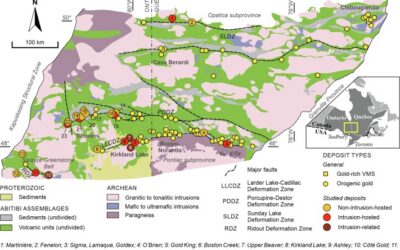
Mineral Exploration in the Abitibi Greenstone Belt: Geology, Deposit Types, and What to Expect in the Field
Image Source: https://www.sciencedirect.com/science/article/abs/pii/S016913682100247X The Abitibi Greenstone Belt produced more gold than almost any other Archean terrane on Earth, and the ground is still generating discovery-stage programs across northern Ontario and...
Beyond the Borehole: How 3D Geotechnical Modeling is De-Risking Modern Mine Design
The difference between a viable project and a costly oversight lies in the "digital twin" of the subsurface. Traditional 2D cross-sections, once the industry standard, are no longer sufficient for the complexities of modern resource extraction and the stringent safety...

Starting a Geology Career in Mining and Mineral Exploration
Graduating with a geology degree opens doors, but it can be hard to know which ones to walk through first. Many new graduates want work that's hands-on, technically meaningful, and connected to real projects, but translating that into an actual job search takes some...

Soil Sampling vs. Magnetic vs. Gravity Surveys in Canada’s Covered Terrain
Canada is home to some of the world’s most promising mineral districts, but many of those opportunities lie beneath cover rather than in clean, exposed outcrops. Across much of the country, exploration teams work in terrain shaped by glaciation, transported...

2026 Regulatory Shifts in Geophysics & Geotechnical Reporting in Canada
For Canadian junior and major exploration firms, the "Qualified Person" (QP) is under more scrutiny than ever. As we move into 2026, the integration of geophysical data into NI 43-101 technical reports has evolved from "supplemental" to "essential." In an era of...
How Geophysical Surveys Support Mineral Exploration in Canada’s Remote and Covered Terrains
Canada is one of the most mineral-rich countries in the world, but much of that potential lies in places that are difficult, expensive, or logistically complex to explore. From vast stretches of the Precambrian Shield to sediment-covered basins and northern regions...

Gravity Surveys in Mineral Exploration: How They Work, What They Reveal, and Why They Matter
In mineral exploration, every decision hinges on understanding what lies beneath the surface before drilling begins. Gravity surveys provide a precise, cost-effective way to map subsurface density variations and uncover geological structures that may host valuable...

Why Magnetic and Gravity Surveys Are Essential for Mineral Exploration in Canada
Canada is one of the most geophysically explored countries in the world. With vast mineral potential spread across the Precambrian Shield, structurally complex greenstone belts, sedimentary basins, and remote northern terrains, Canadian exploration has long relied on...