
As national and international stakeholders intensify efforts to secure reliable mineral supply chains, the North offers significant potential and substantial complexity. While opportunities are expanding, exploration companies must address logistical constraints, regulatory frameworks, environmental considerations, and Indigenous partnerships that are central to operating in these remote areas.
Key Mineral Opportunities in Northern Canada
Increased Demand for Critical Minerals
Global decarbonization and electrification initiatives are driving rapid demand growth for minerals such as lithium, cobalt, rare earth elements, and tungsten. Canada’s Northern Territories contain many of these materials in economically viable concentrations.
For example, the Northwest Territories alone are home to over two-thirds of the minerals listed in Canada’s official Critical Minerals Strategy. This aligns with federal objectives to position the country as a secure and responsible global supplier, supporting not only Canadian industries but also international partners in the U.S., EU, and Asia.
Government Investment and Strategic Support
The Canadian government’s $4 billion Critical Minerals Strategy includes initiatives to support exploration, streamline permitting, and fund enabling infrastructure. This creates a favorable policy environment for projects in the North, which often require substantial upfront investment to overcome access and logistics barriers.
Public geoscience programs are also expanding, providing valuable airborne geophysical data, mineral potential maps, and regional geochemical analyses that lower early-stage exploration risk.
Indigenous Engagement and Economic Collaboration
Indigenous governments and organizations are playing an increasingly active role in mineral development, including land stewardship, permitting processes, and economic partnerships. This trend is reshaping how exploration is conducted across Canada’s North.
Collaborative approaches such as benefit agreements, equity partnerships, and Indigenous-led development initiatives can improve project viability by ensuring alignment with community goals and legal obligations under modern treaties and land claims.
Operational and Strategic Challenges
Infrastructure Limitations
Limited infrastructure continues to be a key obstacle in mining and exploration in Canada. Many potential exploration sites in the North are located hundreds of kilometers from the nearest road, port, or power grid. Companies must often rely on seasonal ice roads, helicopters, and air freight, significantly increasing operating costs and introducing unpredictability.
Recent climate variability, particularly warmer winter temperatures, has also impacted the viability of ice roads, delaying supply deliveries and limiting heavy equipment access. This is raising the urgency for long-term infrastructure investment and alternative logistics planning.
Environmental and Climate-Driven Constraints
The environmental sensitivity of northern ecosystems requires a higher level of due diligence. Projects must conduct rigorous environmental baseline studies and implement plans to minimize disturbance to wildlife, water resources, and permafrost.
Additionally, climate change is directly affecting ground conditions in these regions. Thawing permafrost, altered hydrology, and increased erosion risks are now active factors in exploration planning and field operations.
Regulatory Complexity
Exploration projects in the North are governed by overlapping federal, territorial, and Indigenous regulatory systems. The permitting process can be lengthy and varies across jurisdictions. In some cases, regulatory delays have deterred private-sector investment.
However, industry stakeholders are continuing to work with government bodies to improve clarity and efficiency. Early consultation, documentation, and stakeholder engagement remain key strategies for managing this aspect of northern operations.
Evolving Approaches to Mineral Exploration in Northern Canada
As companies adapt to the operational realities of the North, new methods and technologies are being employed to increase efficiency and reduce impact.
Remote Sensing and Data-Driven Targeting
Innovations in satellite imagery, hyperspectral analysis, and machine learning are improving early-stage target identification, reducing the need for extensive ground-based surveying in the initial phases.
Modular Field Operations
Scalable field teams, mobile camp systems, and adaptable workflows are becoming more common, allowing exploration programs to remain productive despite unpredictable weather and access constraints.
Integrated ESG Practices
Environmental, Social, and Governance (ESG) metrics are being integrated into exploration workflows from the outset. This includes real-time environmental monitoring, community consultation protocols, and transparent impact reporting. ESG is no longer a secondary consideration but an operational priority.
Mineral Exploration Outlook in Canada’s Northern Territories
The mineral potential of Canada’s Northern Territories is well-established, and the current global focus on critical minerals adds urgency to exploration and development in these regions. While challenges remain, particularly related to logistics, permitting, and climate, industry practices are evolving to meet them.
The future of northern exploration will likely involve greater collaboration between governments, Indigenous communities, and private companies, supported by improved data infrastructure and regulatory modernization. Projects that are technically robust, environmentally responsible, and socially collaborative will have the best prospects for long-term success.
Final Thoughts
Mineral exploration in Canada’s remote regions requires a specialized approach—balancing technical, environmental, and social factors. To explore how remote projects can be executed effectively and responsibly, visit Rangefront.com or click the button below to speak with an expert.

ABOUT THE AUTHOR
BRIAN GOSS
President, Rangefront Mining Services
Brian Goss brings over 20 years of experience in gold and mineral exploration. He is the founder and President of Rangefront, a premier geological services and mining consulting company that caters to a large spectrum of clients in the mining and minerals exploration industries. Brian is also a director of Lithium Corp. (OTCQB: LTUM), an exploration stage company specializing in energy storage minerals and from 2014 to 2017, he fulfilled the role of President and Director of Graphite Corp. (OTCQB: GRPH), an exploration stage that specialized in the development of graphite properties. Prior to founding Rangefront, Brian worked as a staff geologist for Centerra Gold on the REN project, as well as various exploration and development projects in the Western United States and Michigan. Brian Goss holds a Bachelor of Science Degree with a major in Geology from Wayne State University in Michigan.
You may also be interested in...

Annual Claim Renewals Updated for 2026: Mining Claim Maintenance & Assessment Information
Late summer is a critical time for the mining and exploration industry. The deadline for Annual Mining Claim Renewals is September 1, and it arrives fast. Whether you’re a small-scale prospector or managing dozens of claims, it’s essential to ensure your filings,...
Combining Drone and Ground Mag Surveys: More Data, Less Time in the Field
A magnetic survey is only as good as the data density behind it. Two survey platforms, flown and walked over the same ground on the same program, can double that density without doubling your budget or your schedule. That is the logic behind Rangefront's approach to...
Yukon Geophysical Surveys: Season Planning and Field Logistics
The Yukon exploration season is shorter than most project managers account for, and the margin for a poorly timed mobilization is close to zero. Between spring break-up, permafrost thaw cycles, and the onset of fall freeze, the usable field window for most ground...
How to Read an IP Pseudosection: Interpreting Chargeability and Resistivity Anomalies Before You Drill
A chargeability anomaly that looks like a porphyry target and turns out to be graphitic shale is a wasted drill hole, a budget hit, and a credibility problem in front of your board. Reading an IP pseudosection correctly before the rig mobilizes is one of the...
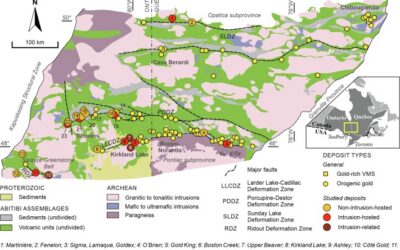
Mineral Exploration in the Abitibi Greenstone Belt: Geology, Deposit Types, and What to Expect in the Field
Image Source: https://www.sciencedirect.com/science/article/abs/pii/S016913682100247X The Abitibi Greenstone Belt produced more gold than almost any other Archean terrane on Earth, and the ground is still generating discovery-stage programs across northern Ontario and...
Beyond the Borehole: How 3D Geotechnical Modeling is De-Risking Modern Mine Design
The difference between a viable project and a costly oversight lies in the "digital twin" of the subsurface. Traditional 2D cross-sections, once the industry standard, are no longer sufficient for the complexities of modern resource extraction and the stringent safety...

Starting a Geology Career in Mining and Mineral Exploration
Graduating with a geology degree opens doors, but it can be hard to know which ones to walk through first. Many new graduates want work that's hands-on, technically meaningful, and connected to real projects, but translating that into an actual job search takes some...

Soil Sampling vs. Magnetic vs. Gravity Surveys in Canada’s Covered Terrain
Canada is home to some of the world’s most promising mineral districts, but many of those opportunities lie beneath cover rather than in clean, exposed outcrops. Across much of the country, exploration teams work in terrain shaped by glaciation, transported...

2026 Regulatory Shifts in Geophysics & Geotechnical Reporting in Canada
For Canadian junior and major exploration firms, the "Qualified Person" (QP) is under more scrutiny than ever. As we move into 2026, the integration of geophysical data into NI 43-101 technical reports has evolved from "supplemental" to "essential." In an era of...
How Geophysical Surveys Support Mineral Exploration in Canada’s Remote and Covered Terrains
Canada is one of the most mineral-rich countries in the world, but much of that potential lies in places that are difficult, expensive, or logistically complex to explore. From vast stretches of the Precambrian Shield to sediment-covered basins and northern regions...

Gravity Surveys in Mineral Exploration: How They Work, What They Reveal, and Why They Matter
In mineral exploration, every decision hinges on understanding what lies beneath the surface before drilling begins. Gravity surveys provide a precise, cost-effective way to map subsurface density variations and uncover geological structures that may host valuable...

Why Magnetic and Gravity Surveys Are Essential for Mineral Exploration in Canada
Canada is one of the most geophysically explored countries in the world. With vast mineral potential spread across the Precambrian Shield, structurally complex greenstone belts, sedimentary basins, and remote northern terrains, Canadian exploration has long relied on...