
Magnetic surveys, commonly known as mag surveys, are one of the most valuable and widely used geophysical tools in mineral exploration. They provide rapid, cost-effective insight into subsurface geology by measuring variations in the Earth’s magnetic field. These variations reflect changes in lithology, structure, alteration, and mineral content, making magnetic surveys indispensable in everything from early-stage reconnaissance to advanced drill targeting.
This article explains how magnetic surveys work, what they can identify, and how they integrate with modern exploration strategies.
Quick Links
Use the links below to explore the different sections of this article:
What is a Magnetic Survey
How Magnetic Surveys Work
What Magnetic Surveys Can Identify
Benefits of Magnetic Surveys in Exploration
Airborne vs. Ground Magnetic Surveys
Where Magnetic Surveys Fit in an Exploration Program
Common Costs of Mag Surveys
FAQs About Magnetic Surveys
What Is a Magnetic Survey?
A magnetic survey measures small fluctuations in the Earth’s magnetic field using sensitive instruments called magnetometers. These variations occur because rocks have different magnetic properties, such as magnetic susceptibility or remanent magnetization, depending on their mineral composition.
In mineral exploration, these magnetic signals help reveal the presence of mafic and ultramafic intrusions, iron-rich formations, major structures, lithological boundaries, and other geological features that frequently control mineralization.
Magnetic surveys offer one of the highest data-density, lowest-cost methods for understanding large areas quickly, making them an important part of mineral exploration programs worldwide.
How Magnetic Surveys Work
The strength of magnetic surveys lies not only in their sensitivity but also in the speed and efficiency with which data can be collected across vast areas.
1. Field Acquisition
Magnetic surveys can be performed either from the air or on the ground:
- Airborne Magnetic Surveys
Airborne surveys collect magnetic readings from drones, fixed-wing aircraft, or helicopters flying precise grid patterns. This method is extremely efficient for regional mapping, allowing explorers to gather high-quality data over hundreds or thousands of square kilometers in a short time. - Ground Magnetic Surveys
Ground crews collect data at close station spacing, often just a few meters apart. This approach provides higher resolution than airborne surveys, making it ideal for detailed target refinement or drill planning in smaller project areas.
In both cases, a base-station magnetometer is deployed nearby to record natural variations in the Earth’s magnetic field throughout the day. These readings ensure that diurnal drift can be removed from the final dataset.
2. Data Processing and Corrections
The raw data collected by magnetometers must be carefully corrected before it can be interpreted. These corrections account for natural, instrumental, and cultural influences on the magnetic signal. Corrections include:
- Diurnal variation: Natural fluctuations in the magnetic field that occur over hours.
- Latitude correction: Adjusts for changes in the Earth’s magnetic field strength across different regions.
- Cultural noise: Metal infrastructure such as fences, pipelines, or vehicles that create unwanted signals.
- Aircraft or system noise (for airborne surveys): Corrected through filtering and calibration.
After corrections, data is gridded and enhanced through derivative products such as Reduced-to-Pole (RTP), analytic signal, tilt derivative, and first vertical derivative (1VD) maps. These enhanced views help geophysicists see structure, lithological trends, and subtle anomalies more clearly.
3. Interpretation
Interpreting magnetic data requires a nuanced understanding of both geology and geophysics. Geophysicists analyze anomaly shape, gradient, amplitude, and continuity while integrating magnetic data with:
- Geological maps
- Structural mapping
- Gravity surveys
- EM or IP surveys
- Drillhole data
- 2D/3D geological models
It is this integration, not the magnetic data alone, that produces the clearest and most reliable exploration insights.
What Magnetic Surveys Can Identify
Magnetic surveys are exceptionally versatile and can reveal a wide range of geological features. Some of the highest-value applications include:
1. Mafic and Ultramafic Intrusions
These rock types often contain minerals like magnetite, which create strong magnetic signatures. This makes magnetic surveys invaluable in exploring for Ni-Cu-PGE systems or komatiite-hosted deposits, where the distribution of ultramafic units controls mineralization potential.
2. Iron Ore and Magnetite-Rich Bodies
Iron formations often produce intense magnetic anomalies due to their high magnetite content.
Mag surveys are therefore a primary exploration tool for iron ore districts and for detecting magnetite-bearing skarns or BIF units beneath cover.
3. Faults, Shear Zones, and Structural Controls
Magnetic patterns often bend, break, or offset where major faults occur.
- Minor changes in the magnetic signal can highlight subtle structures
- Larger disruptions may indicate significant fault offsets or shear zones
- Lineaments detected in mag data often correlate with mineralized corridors
This structural insight is among the most valuable outputs of magnetic surveys.
4. Lithological Boundaries and Alteration Zones
Mag surveys can distinguish between rock units with different magnetic susceptibilities:
- Sediments vs. volcanics
- Granite vs. greenstone
- Layered intrusions
- Areas of magnetite destruction caused by hydrothermal alteration
These boundaries refine geological models and help explorers focus on the most prospective units.
5. Basin Architecture and Depth to Basement
In sediment-covered terrains, mag surveys are one of the best tools for mapping:
- Depth to basement
- Basin margins
- Structural blocks
- Paleotopography
This is particularly useful for sediment-hosted deposits and lithium brine exploration.
Benefits of Magnetic Surveys in Exploration
Mag surveys provide a powerful combination of speed, coverage, and geological insight.
Fast and Cost-Effective
Airborne surveys cover vast areas quickly, often costing only a fraction of other geophysical methods, while ground surveys add detailed resolution when needed for project-scale refinement.
Sensitive to Geological Features That Matter
Magnetics directly responds to changes in magnetic minerals and rock types, making it ideal for mapping:
- Intrusions
- Faults
- Iron formations
- Mafic/ultramafic units
- Magnetic destruction from alteration
Not Limited by Conductive Overburden
Unlike EM or IP, magnetic surveys work effectively through:
- Conductive clays
- Dry sands
- Basalts
- Thick cover
This reliability makes magnetics one of the best tools in difficult terrains.
Integrates Extremely Well with Other Geophysical Data
- Main point: Mag + Gravity enhances structural clarity. These two methods complement each other, with magnetics mapping magnetism and gravity mapping density—creating a clearer geological picture.
- Main point: Mag + EM or IP helps characterize ore systems. Magnetic host rocks combined with conductive or chargeable mineralization produce distinctive exploration signatures.
This integration reduces uncertainty and drives better drilling decisions.
Airborne vs. Ground Magnetic Surveys
Both survey types offer important advantages, and many exploration programs use a combination of the two.
Airborne Magnetic Surveys (Drone or Aircraft)
- Best for regional-scale mapping
- Fast coverage over large areas
- Lower resolution but highly cost-efficient
Ground Magnetic Surveys
- Best for detailed project-scale evaluation
- High-density data for structural interpretation
- Ideal for narrowing wide anomalies to drill-ready targets
Airborne magnetics often sets the stage; ground magnetics refines the play.
Where Magnetic Surveys Fit in an Exploration Program
Mag surveys usually support exploration in several phases:
- Regional Target Generation. Airborne magnetic data outlines major structural corridors, intrusive complexes, and lithological domains. This helps teams quickly identify where to focus further work.
- Project-Scale Refinement. Once prospective zones are identified, ground mag adds detail that clarifies anomaly shape, structure, and drill positioning.
- Modeling and Structural Interpretation. Magnetic data feeds directly into 2D and 3D geological models, improving their accuracy and reliability.
- Advanced Exploration and Resource Definition. Even in late-stage programs, magnetics continues to support:
- Mineralized trend modeling
- Host-unit mapping
- Structural constraints
- Reporting requirements (NI 43-101, S-K 1300)
Common Costs of Mag Surveys
- Airborne magnetics: $8-$25 per line-km
- Ground magnetics: $80-$200 per km
- Processing and modeling: dependent on survey size and complexity
Given its interpretive value, magnetic data is widely regarded as one of the best-cost-to-insight geophysical methods in early-stage exploration.
FAQ About Magnetic Surveys
Can magnetic surveys detect gold?
Not directly, but they identify structures, intrusions, and alteration patterns that help vector toward gold mineralization.
How deep can magnetic surveys “see”?
Depending on magnetic contrast, mag surveys can detect features from shallow depths to several kilometers below surface.
Do magnetic surveys work under cover?
Yes. Magnetics is not affected by conductive overburden, making it ideal for covered terrains.
Are magnetic surveys affected by man-made metal?
Ground surveys can be influenced by cultural noise, but proper planning and QC minimize interference.
Final Thoughts
Magnetic surveys offer an unmatched combination of speed, affordability, and geological insight. They help explorers map structure, identify intrusive bodies, highlight iron-rich units, and refine drill targets with precision. When integrated with gravity, EM, IP, or drilling data, magnetic surveys become one of the most influential tools in building a complete, confident geological model.

ABOUT THE AUTHOR
BRIAN GOSS
President, Rangefront Mining Services
Brian Goss brings over 20 years of experience in gold and mineral exploration. He is the founder and President of Rangefront, a premier geological services and mining consulting company that caters to a large spectrum of clients in the mining and minerals exploration industries. Brian is also a director of Lithium Corp. (OTCQB: LTUM), an exploration stage company specializing in energy storage minerals and from 2014 to 2017, he fulfilled the role of President and Director of Graphite Corp. (OTCQB: GRPH), an exploration stage that specialized in the development of graphite properties. Prior to founding Rangefront, Brian worked as a staff geologist for Centerra Gold on the REN project, as well as various exploration and development projects in the Western United States and Michigan. Brian Goss holds a Bachelor of Science Degree with a major in Geology from Wayne State University in Michigan.
You may also be interested in...

Annual Claim Renewals Updated for 2026: Mining Claim Maintenance & Assessment Information
Late summer is a critical time for the mining and exploration industry. The deadline for Annual Mining Claim Renewals is September 1, and it arrives fast. Whether you’re a small-scale prospector or managing dozens of claims, it’s essential to ensure your filings,...
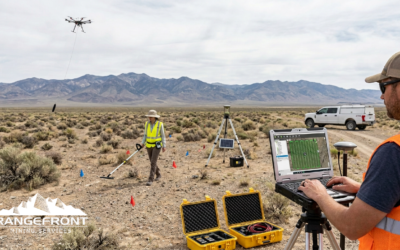
Combining Drone and Ground Mag Surveys: More Data, Less Time in the Field
A magnetic survey is only as good as the data density behind it. Two survey platforms, flown and walked over the same ground on the same program, can double that density without doubling your budget or your schedule. That is the logic behind Rangefront's approach to...
Yukon Geophysical Surveys: Season Planning and Field Logistics
The Yukon exploration season is shorter than most project managers account for, and the margin for a poorly timed mobilization is close to zero. Between spring break-up, permafrost thaw cycles, and the onset of fall freeze, the usable field window for most ground...
How to Read an IP Pseudosection: Interpreting Chargeability and Resistivity Anomalies Before You Drill
A chargeability anomaly that looks like a porphyry target and turns out to be graphitic shale is a wasted drill hole, a budget hit, and a credibility problem in front of your board. Reading an IP pseudosection correctly before the rig mobilizes is one of the...
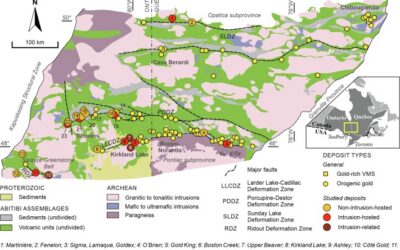
Mineral Exploration in the Abitibi Greenstone Belt: Geology, Deposit Types, and What to Expect in the Field
Image Source: https://www.sciencedirect.com/science/article/abs/pii/S016913682100247X The Abitibi Greenstone Belt produced more gold than almost any other Archean terrane on Earth, and the ground is still generating discovery-stage programs across northern Ontario and...
Beyond the Borehole: How 3D Geotechnical Modeling is De-Risking Modern Mine Design
The difference between a viable project and a costly oversight lies in the "digital twin" of the subsurface. Traditional 2D cross-sections, once the industry standard, are no longer sufficient for the complexities of modern resource extraction and the stringent safety...

Starting a Geology Career in Mining and Mineral Exploration
Graduating with a geology degree opens doors, but it can be hard to know which ones to walk through first. Many new graduates want work that's hands-on, technically meaningful, and connected to real projects, but translating that into an actual job search takes some...

Soil Sampling vs. Magnetic vs. Gravity Surveys in Canada’s Covered Terrain
Canada is home to some of the world’s most promising mineral districts, but many of those opportunities lie beneath cover rather than in clean, exposed outcrops. Across much of the country, exploration teams work in terrain shaped by glaciation, transported...

2026 Regulatory Shifts in Geophysics & Geotechnical Reporting in Canada
For Canadian junior and major exploration firms, the "Qualified Person" (QP) is under more scrutiny than ever. As we move into 2026, the integration of geophysical data into NI 43-101 technical reports has evolved from "supplemental" to "essential." In an era of...
How Geophysical Surveys Support Mineral Exploration in Canada’s Remote and Covered Terrains
Canada is one of the most mineral-rich countries in the world, but much of that potential lies in places that are difficult, expensive, or logistically complex to explore. From vast stretches of the Precambrian Shield to sediment-covered basins and northern regions...

Gravity Surveys in Mineral Exploration: How They Work, What They Reveal, and Why They Matter
In mineral exploration, every decision hinges on understanding what lies beneath the surface before drilling begins. Gravity surveys provide a precise, cost-effective way to map subsurface density variations and uncover geological structures that may host valuable...

Why Magnetic and Gravity Surveys Are Essential for Mineral Exploration in Canada
Canada is one of the most geophysically explored countries in the world. With vast mineral potential spread across the Precambrian Shield, structurally complex greenstone belts, sedimentary basins, and remote northern terrains, Canadian exploration has long relied on...