Induced Polarization (IP) Survey Services for Mining & Mineral Exploration
Identify sulfide mineralization, define or bodies, and reduce drill risk.
Induced Polarization (IP) surveys are one of the most effective tools in the mineral exploration toolkit — and one of the most misapplied. When designed and interpreted correctly, IP data can mean the difference between a well-targeted drill program and an expensive miss. Rangefront’s geophysical team brings deep technical expertise in IP survey design, field execution, data processing, and 3D inversion modeling, giving your project the subsurface clarity it needs to move forward with confidence.
Whether you’re advancing a grassroots exploration target or tightening up a resource model ahead of a feasibility study, Rangefront’s IP services are built around your project goals.
What is an Induced Polarization (IP) Survey?
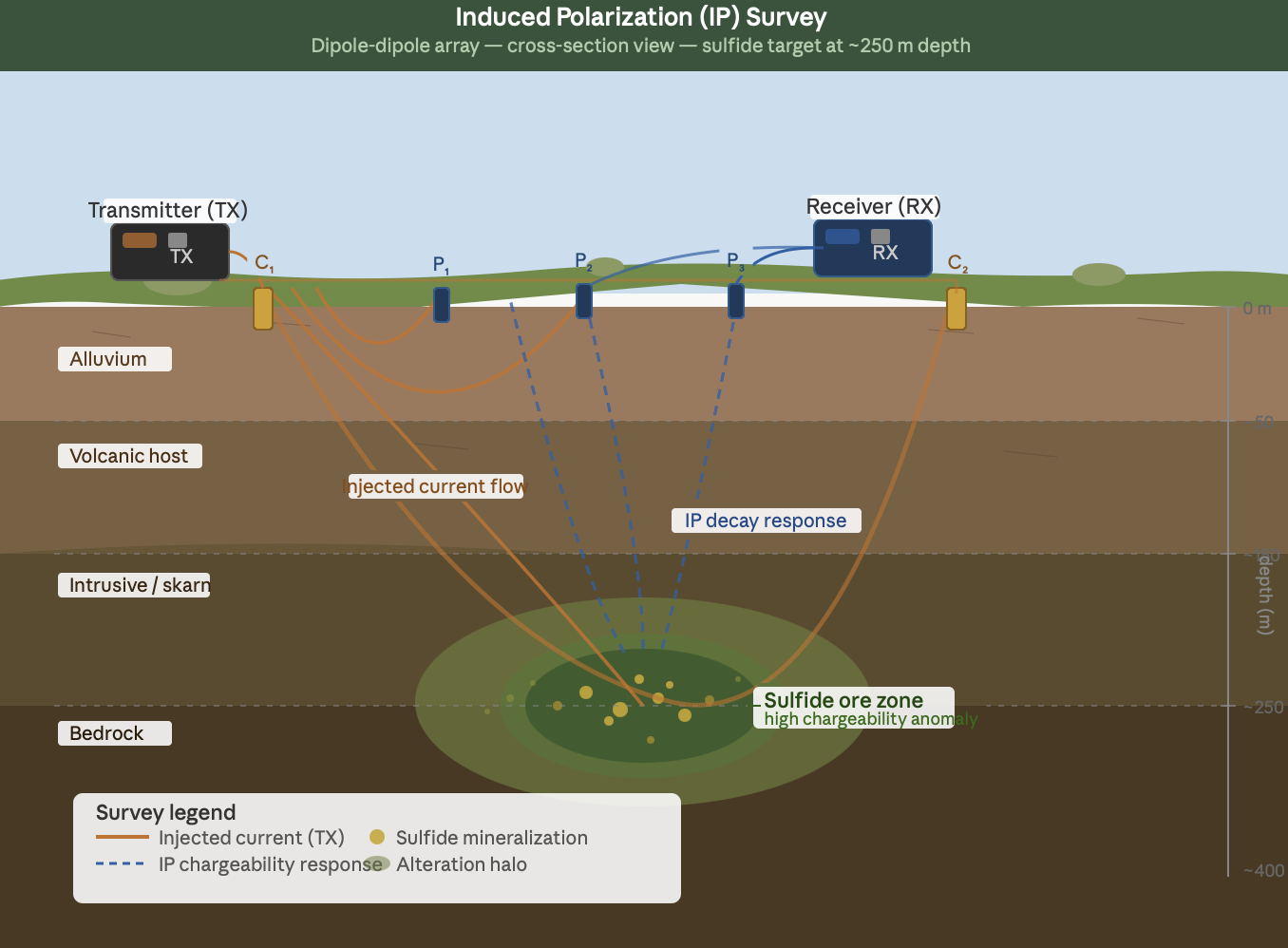
Induced Polarization is a ground-based geophysical technique that measures two key subsurface electrical properties: chargeability and resistivity. When an electrical current is transmitted into the ground through a series of electrodes, certain materials, most notably sulfide minerals, temporarily store that charge. When the current is switched off, the rate at which that stored charge decays is recorded. This decay signature (the chargeability response) is what distinguishes electronically conductive mineral assemblages from the background geology.
Resistivity data collected simultaneously describes how strongly the subsurface resists electrical current flow, providing a complementary picture of lithology, structure, alteration, and fluid content.
Together, these two datasets produce a remarkably detailed view of what lies beneath the surface — without turning a single meter of drill core.
Applications: Where IP Surveys Add the Most Value
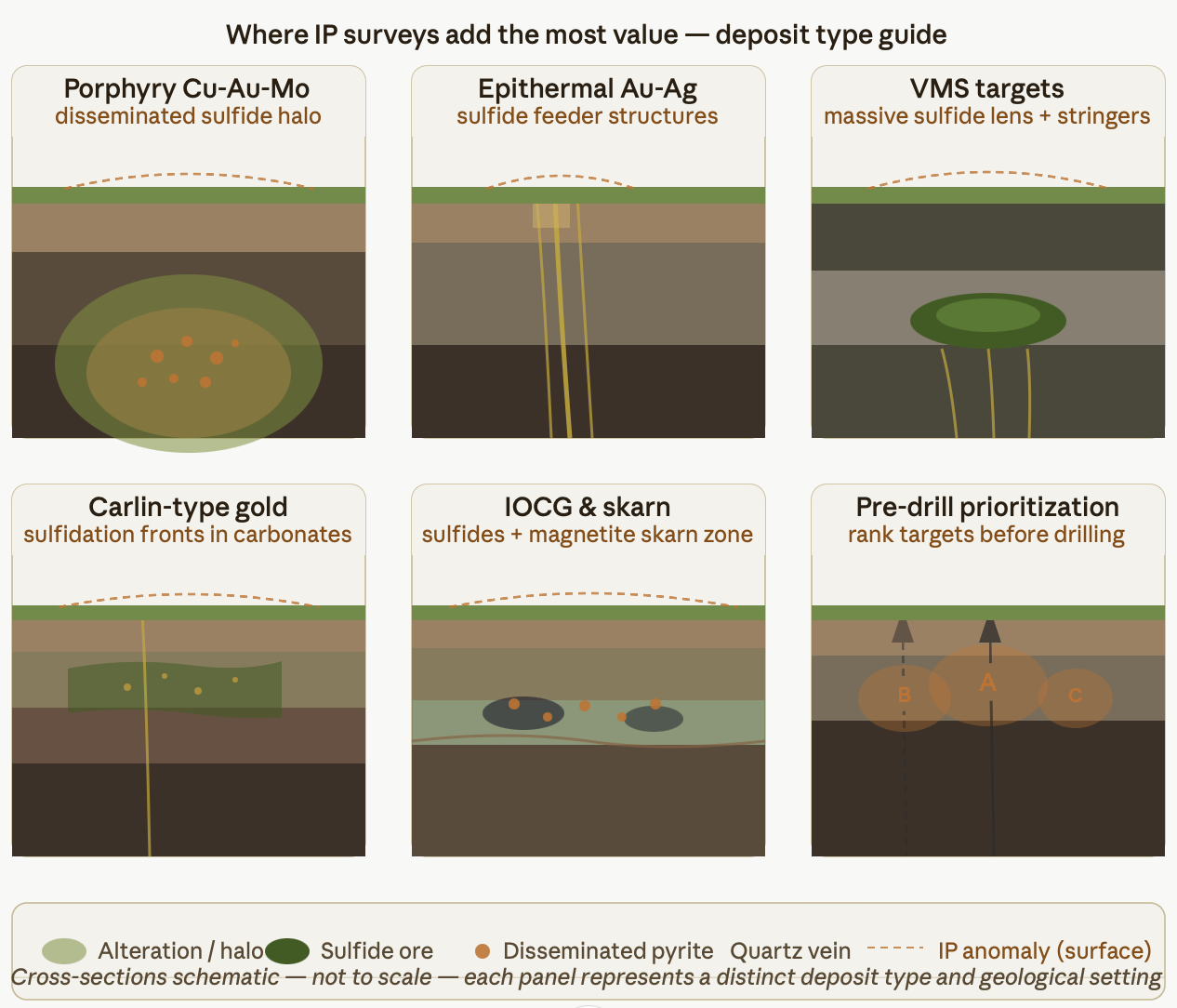
- Porphyry Cu-Au-Mo Exploration. Disseminated sulfide mineralization in porphyry systems is an ideal IP target. Pyrite halos surrounding Cu-Au core zones produce strong chargeability responses that can be detected at depth well in advance of drilling. IP surveys are a standard pre-drill tool on any serious porphyry program.
- Epithermal Gold & Silver Systems. In low-sulfidation and intermediate-sulfidation epithermal systems, IP can map sulfide-bearing feeder structures and alteration zones that are obscured at surface by cover or oxidation. Combined with magnetics and geology, IP helps vector toward the productive core of these systems.
- Volcanogenic Massive Sulfide (VMS) Targets. VMS deposits present strong, often compact IP anomalies. Survey design is critical in these settings — proper array orientation relative to structural strike can make or break the anomaly response.
- Sediment-Hosted & Carlin-Type Gold. While Carlin-type gold deposits can be geophysically subtle, IP is useful for mapping sulfidation fronts in reactive carbonate sequences and identifying structural conduits that localize ore.
- IOCG & Skarn Systems. Iron oxide copper-gold systems and skarns often host significant sulfide assemblages that generate excellent IP responses. In these settings, IP combined with magnetics and gravity provides a powerful multi-parameter targeting package.
- Pre-Drill Target Prioritization. Regardless of deposit type, IP surveys are one of the most cost-effective ways to prioritize drill targets, test conceptual models, and reduce exploration risk before committing to a drill program. The cost of a well-designed IP program is almost always a fraction of a single poorly sited drill hole.
- Resource Definition & Ore Body Delineation. As a project advances, IP surveys can assist with infill coverage, extending known mineralization along strike or down dip, and tightening the geometry of resource models ahead of NI 43-101, S-K 1300, or JORC reporting.
Key Technical Parameters: What We Measure and Why It Matters
mV/V or ms
Chargeability
The primary IP measurement, high chargeability typically reflects the presence of electronically conductive minerals, such as sulfides, graphite, and in some cases magnetite. In exploration contexts, chargeability anomalies are the targets. Understanding the geological cause of the chargeability response (sulfide mineralization vs. graphitic shale vs. clay alteration) is where experienced interpretation earns its value.
Ohm-m
Resistivity
Resistivity defines the electrical architecture of the subsurface. Silicified zones tend to be resistive; clay-altered or water-saturated zones are conductive. In many systems, ore-grade mineralization is hosted in zones where chargeability is high and resistivity is moderate to high — the classic “IP bullseye” pattern that precedes many significant discoveries.
milliradians
Phase
In frequency-domain IP, phase measurements provide additional discrimination between different types of polarizable materials and can improve the resolution of subtle mineralization in complex geological settings.
How Rangefront Conducts IP Surveys
Rangefront follows a rigorous, project-specific approach to every IP program. Our workflow is designed to maximize data quality, minimize field time, and ensure the results are interpretable and actionable.
Survey Design & Project Planning
Before electrodes go in the ground, our geophysicists work with your project team to define survey objectives, target depths, and optimal electrode array configurations. Dipole-dipole, pole-dipole, and gradient arrays each have strengths depending on terrain, target geometry, and depth of investigation — and the wrong choice costs money. We get this right from the start.
Grid Setup & Electrode Deployment
Survey lines are laid out with precision over the area of interest. Electrode spacing and line orientation are selected to maximize sensitivity to your specific target type — whether that’s a deep porphyry sulfide system, a shallow epithermal vein corridor, or a structurally controlled VMS target.
Current Injection & Data Acquisition
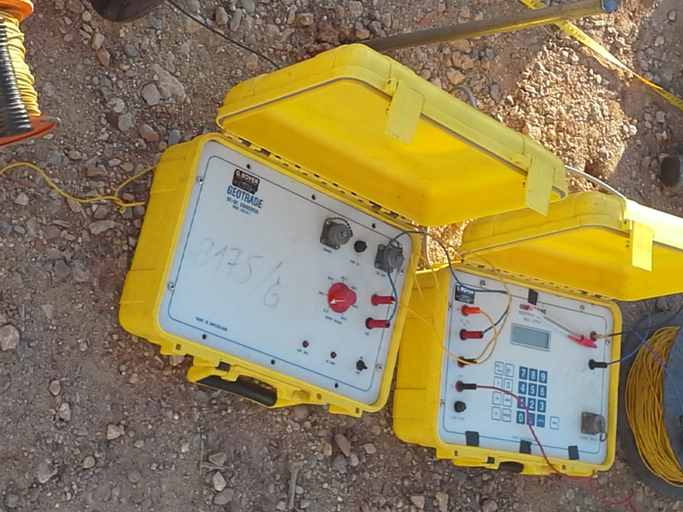
A controlled electrical current is injected through transmitter electrodes. Our field teams use modern, high-powered IP transmitters capable of achieving the current injection levels needed to reach depth in resistive terrain — a common challenge in arid Western U.S. and Canadian Shield environments.
Data QC, Processing & Inversion Modeling
Raw IP and resistivity data are quality-controlled in the field and processed using industry-standard software. We deliver 2D pseudosection models and, where appropriate, full 3D inversion models that integrate seamlessly with your geological database and 3D modeling environment.
Integrated Interpretation & Reporting
Data doesn’t interpret itself. Rangefront’s geophysicists provide expert interpretation within the geological context of your project, identifying chargeability and resistivity anomalies, ranking targets by exploration priority, and providing clear recommendations for follow-up drilling.
Why Choose Rangefront for IP Surveys
Rangefront’s IP crews operate across a wide range of environments, including Nevada, Utah, Idaho, Arizona, Washington, Oregon, Alaska, Montana, BC, Yukon, NWT, Alberta, Ontario, Quebec, and Newfoundland.
Rangefront has the field experience and logistical capability to execute IP programs in remote, high-altitude, and otherwise challenging access environments. Our crews are vetted, experienced, and supervised by qualified geophysicists.
Working with us means:
✔ Technical Depth. Rangefront’s geophysical team includes professionals with direct mineral exploration experience that has been used to make drill decisions; not just process and deliver it. That context changes the quality of interpretation.
✔ End-to-End Service. From program design through field acquisition, data processing, 3D inversion, and final interpretation report, Rangefront manages the full workflow. You’re not coordinating between multiple contractors or reconciling inconsistent deliverable formats.
✔ Integration with Geology. IP data is most powerful when interpreted in the context of surface geology, geochemistry, and drill results. Rangefront’s multi-disciplinary team can integrate your existing datasets, including soil geochemistry, mag surveys, structural mapping, and drill logs into a unified interpretation framework.
✔ Transparent Pricing & Communication.Rangefront operates on straightforward project pricing with clear scope definitions. You’ll know what you’re getting, what it costs and when you’ll receive the deliverables, all before the project starts.
✔ Proven Track Record Across Deposit Types. With over a decade of work across the Western U.S. and Canada, Rangefront has IP experience across the full spectrum of deposit types that define North American mineral exploration from Nevada gold systems to BC porphyries to Canadian Shield VMS targets.
IP Surveys in the Context of a Broader Geophysical Program
IP surveys are powerful on their own, but they’re most effective when integrated with complementary geophysical techniques. Rangefront offers a full suite of geophysical services that work together to build the most complete possible picture of your project’s subsurface:
- Magnetic (Mag) Surveys — map lithology, structure, and magnetite-bearing alteration zones; often the logical first-pass survey before IP
- Gravity Surveys — detect density contrasts that reflect lithological boundaries, intrusive contacts, and massive sulfide bodies
- CSAMT (Controlled Source Audio-Frequency Magnetotellurics) — deep resistivity mapping for targets beyond typical IP depth penetration
- FDEM (Frequency Domain Electromagnetics) — rapid reconnaissance for conductors in areas with accessible near-surface targets
- Ground Penetrating Radar (GPR) — high-resolution shallow imaging for infrastructure and geotechnical applications
Multi-method geophysical programs, properly designed, deliver far more interpretive value than any single technique alone. Rangefront can design and execute integrated programs across all of these methods.
Common questions
Frequently asked questions
about IP surveys
Common questions about induced polarization surveys — answered by Rangefront's geophysical team.
Still have questions about your project?
Talk directly with one of our geophysics experts — no obligation, no sales pitch.