
Mineral resources and mineral reserves are crucial data points in a mining company’s operations. In mining and exploration, the terms “Mineral Resource” and “Mineral Reserve” can be confusing—and are often used incorrectly or even interchangeably. Mineral resources and reserves have a number of differentiating factors which are important to understand for reporting purposes, feasibility studies, financing, operational strategy, and more.
WHAT IS A MINERAL RESOURCE?
A mineral resource is a concentration of mineral deposits of economic interest within the earth’s crust. To count as a mineral resource, these minerals must be in a form, grade, and quantity that is of economic interest for extraction.
Mineral resources are discovered during the exploration phase of a mineral project. Multiple geophysical tests are typically performed to identify imperative details about the mineral deposit, including the location, quantity, grade, geological characteristics, location, depth, feasibility, and more. This information will be used to determine the feasibility and economic benefit of mining the resource, thus helping to determine if the mineral can be considered a mineral reserve.
WHAT IS A MINERAL RESERVE?
The definition of a mineral reserve is the portion of a mineral resource that can be realistically and economically mined. A mineral reserve must be proven by a detailed evaluation program, usually involving drilling and geophysical testing, to prove that a deposit is of sufficient quantity and quality to be defined as a viable, economically mineable reserve.
A mineral reserve will typically include allowances for losses that may occur during the extraction process as defined by pre-feasibility or feasibility studies. To attain the distinction of being a “reserve,” this resource must also be fully evaluated and deemed commercially viable to work.
Mineral reserves are typically defined as probable or proven reserves. Proven reserves are reserves where the spatial information of the reserve, including size, shape, and depth, as well as mineral content of the reserves are well-established. Probable reserves have some of the same qualities of a proven reserve, but may have sites for inspection, sampling, or measurement that are farther apart or otherwise less adequately spaced, which makes the data less reliable than for proven reserves.
WHAT IS THE DIFFERENCE BETWEEN A MINERAL RESOURCE AND MINERAL RESERVE?
The definition of a mineral reserve is stricter than that of a mineral resource. E.g., all mineral reserves are mineral resources, but not all mineral resources are a mineral reserve. Mineral reserves must be economically mineable based on location, quantity, grade, geological characteristics, feasibility, and more. Mineral resources, however, are a report of the minerals in the mining area but not necessarily yet proven to be economically mineable.
FINAL THOUGHTS
Mineral resources and mineral reserves are the backbone of a successful mining project. If your company requires expertise to produce data for resources and reserves or operational strategy to maximize your yields, contact the experts at Rangefront Mining Services today.

ABOUT THE AUTHOR
BRIAN GOSS
President, Rangefront Mining Services
Brian Goss brings over 20 years of experience in gold and mineral exploration. He is the founder and President of Rangefront, a premier geological services and mining consulting company that caters to a large spectrum of clients in the mining and minerals exploration industries. Brian is also a director of Lithium Corp. (OTCQB: LTUM), an exploration stage company specializing in energy storage minerals and from 2014 to 2017, he fulfilled the role of President and Director of Graphite Corp. (OTCQB: GRPH), an exploration stage that specialized in the development of graphite properties. Prior to founding Rangefront, Brian worked as a staff geologist for Centerra Gold on the REN project, as well as various exploration and development projects in the Western United States and Michigan. Brian Goss holds a Bachelor of Science Degree with a major in Geology from Wayne State University in Michigan.
You may also be interested in...

Annual Claim Renewals Updated for 2026: Mining Claim Maintenance & Assessment Information
Late summer is a critical time for the mining and exploration industry. The deadline for Annual Mining Claim Renewals is September 1, and it arrives fast. Whether you’re a small-scale prospector or managing dozens of claims, it’s essential to ensure your filings,...
Combining Drone and Ground Mag Surveys: More Data, Less Time in the Field
A magnetic survey is only as good as the data density behind it. Two survey platforms, flown and walked over the same ground on the same program, can double that density without doubling your budget or your schedule. That is the logic behind Rangefront's approach to...
Yukon Geophysical Surveys: Season Planning and Field Logistics
The Yukon exploration season is shorter than most project managers account for, and the margin for a poorly timed mobilization is close to zero. Between spring break-up, permafrost thaw cycles, and the onset of fall freeze, the usable field window for most ground...
How to Read an IP Pseudosection: Interpreting Chargeability and Resistivity Anomalies Before You Drill
A chargeability anomaly that looks like a porphyry target and turns out to be graphitic shale is a wasted drill hole, a budget hit, and a credibility problem in front of your board. Reading an IP pseudosection correctly before the rig mobilizes is one of the...
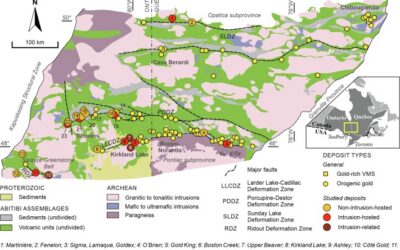
Mineral Exploration in the Abitibi Greenstone Belt: Geology, Deposit Types, and What to Expect in the Field
Image Source: https://www.sciencedirect.com/science/article/abs/pii/S016913682100247X The Abitibi Greenstone Belt produced more gold than almost any other Archean terrane on Earth, and the ground is still generating discovery-stage programs across northern Ontario and...
Beyond the Borehole: How 3D Geotechnical Modeling is De-Risking Modern Mine Design
The difference between a viable project and a costly oversight lies in the "digital twin" of the subsurface. Traditional 2D cross-sections, once the industry standard, are no longer sufficient for the complexities of modern resource extraction and the stringent safety...

Starting a Geology Career in Mining and Mineral Exploration
Graduating with a geology degree opens doors, but it can be hard to know which ones to walk through first. Many new graduates want work that's hands-on, technically meaningful, and connected to real projects, but translating that into an actual job search takes some...
Soil Sampling vs. Magnetic vs. Gravity Surveys in Canada’s Covered Terrain
Canada is home to some of the world’s most promising mineral districts, but many of those opportunities lie beneath cover rather than in clean, exposed outcrops. Across much of the country, exploration teams work in terrain shaped by glaciation, transported...

2026 Regulatory Shifts in Geophysics & Geotechnical Reporting in Canada
For Canadian junior and major exploration firms, the "Qualified Person" (QP) is under more scrutiny than ever. As we move into 2026, the integration of geophysical data into NI 43-101 technical reports has evolved from "supplemental" to "essential." In an era of...
How Geophysical Surveys Support Mineral Exploration in Canada’s Remote and Covered Terrains
Canada is one of the most mineral-rich countries in the world, but much of that potential lies in places that are difficult, expensive, or logistically complex to explore. From vast stretches of the Precambrian Shield to sediment-covered basins and northern regions...

Gravity Surveys in Mineral Exploration: How They Work, What They Reveal, and Why They Matter
In mineral exploration, every decision hinges on understanding what lies beneath the surface before drilling begins. Gravity surveys provide a precise, cost-effective way to map subsurface density variations and uncover geological structures that may host valuable...

Why Magnetic and Gravity Surveys Are Essential for Mineral Exploration in Canada
Canada is one of the most geophysically explored countries in the world. With vast mineral potential spread across the Precambrian Shield, structurally complex greenstone belts, sedimentary basins, and remote northern terrains, Canadian exploration has long relied on...