
Expected Impacts of 2025 U.S. Tariffs on the Mining Sector
Operational Costs and Supply Chain Disruptions
Mining companies heavily reliant on international equipment, parts, and chemicals are seeing sharp cost increases. These tariffs apply to machinery, technology, and materials sourced from major manufacturing hubs, including China, Europe, and Southeast Asia.
Australia’s mining sector, closely tied to global demand and investment flows, felt the impact immediately. Following the announcement of the tariffs in April 2025, the S&P/ASX 200 dropped 1.8%—more than $40 billion in market value—while mining giants like Rio Tinto and Woodside experienced share price declines of over 5% and 4%, respectively (The Guardian, 2025).
These economic signals reflect the high sensitivity of mining markets to global policy changes. Equipment delays, cost overruns, and renegotiated supplier contracts are becoming increasingly common.
Volatility in Commodity Prices
Tariff-driven uncertainty is creating volatility in commodity markets. While critical minerals like lithium, nickel, and rare earths are experiencing price surges due to potential supply constraints, base metals such as copper and iron ore have seen erratic trading amid fears of slowed global economic growth.
Tariff Exemptions for Critical Minerals
The Trump administration plans exemptions for certain critical minerals to avoid disrupting sectors tied to national security and advanced manufacturing. Materials like lithium, rare earth elements, and graphite—integral to electric vehicles, batteries, and defense systems—are expected to be excluded from the 10% baseline tariff (White House, 2025).
However, the exemptions are incomplete. In many cases, the minerals themselves may be tariff-free, but the chemicals, components, or machines used to extract or refine them are not. This policy inconsistency has left mining companies facing logistical headaches and legal ambiguity when assessing overall project costs (China Briefing, 2025).
Strategic Realignments in the Mining Industry
Supply Chain Diversification
In an effort to mitigate risk and reduce exposure to tariffs, mining companies are shifting toward a more diversified sourcing model. This includes:
- Seeking suppliers from non-tariffed countries like Canada, Mexico, Australia, and Brazil
- Investing in local manufacturing of mining inputs such as explosives, equipment parts, and processing chemicals
- Pursuing vertical integration, where companies control more of the supply chain to avoid third-party dependencies
Increased Domestic Exploration
The Trump administration has emphasized domestic resource development as a path to economic independence and resilience. This message has found support among mining companies, who are now investing in U.S.-based exploration projects at a faster pace.
Several projects targeting lithium (Nevada), rare earths (Texas and Wyoming), and copper (Arizona and Montana) have reported new funding rounds, driven by investor interest in tariff-safe operations and the long-term demand outlook for energy transition minerals.
Additionally, streamlining of federal permitting processes is expected to accelerate U.S. mining startups, although concerns remain over environmental regulations and public opposition in certain states.
Impacts of Recent Tariffs on Junior and Mid-Tier Miners
Smaller firms, especially exploration-stage companies, are navigating a precarious path. With limited capital and often no revenue, junior miners are more vulnerable to increased costs for drilling equipment, lab analysis, and geophysical surveys.
However, the shifting focus toward domestic and tariff-exempt operations has created unique opportunities. Companies with assets in North America, Australia, and Chile are attracting more investor attention than those in regions exposed to tariffs or geopolitical instability.
Government grants, loan guarantees, and partnerships with U.S.-based manufacturers are emerging as tools to help these companies stay competitive.
International Reactions and Retaliation
No tariff action is without consequences. China responded swiftly to the U.S. measures by threatening to restrict exports of key rare earth elements and minerals critical to defense and technology production. This has raised alarms in Europe and North America, where supply chain vulnerabilities for these minerals are now a top concern.
Countries like Australia, Canada, and the UK are reevaluating trade and defense cooperation to counterbalance China’s leverage. The current climate is encouraging the development of “friendshoring” alliances—where trade and supply chains are consolidated among geopolitical allies.
Accelerated Investment in Emerging Mining Regions
Emerging markets in Africa and South America are receiving renewed attention as companies seek to reduce dependency on China. The U.S. government has signaled its intention to fund strategic mineral partnerships in countries such as the Democratic Republic of Congo, Zambia, and Argentina (Reuters, 2025).
These investments could bring much-needed infrastructure and regulatory improvements to resource-rich but underdeveloped regions. However, geopolitical risk and corruption remain significant hurdles that companies must navigate carefully.
Technological Adaptation and Innovation
Tariff pressures are also accelerating innovation in mining. Companies are investing in:
- Automation and robotics to offset higher equipment costs and labor shortages
- Recycling and urban mining, reducing reliance on imported raw materials
- Advanced geological modeling to enhance the efficiency of exploration efforts
U.S.-based mining technology firms are likely to benefit from “buy American” provisions and heightened demand for alternative sourcing solutions.
Outlook: Risk and Opportunity in a Shifting Landscape in Mining After April 2025’s Tariffs
Despite the challenges, the outlook for mining remains optimistic—especially for companies aligned with strategic priorities like energy transition and national defense.
Key drivers that will shape the sector over the next 12–24 months include:
- Government policy clarity on mineral exemptions and domestic development incentives
- Global coordination on critical mineral supply chains and standards
- Investor appetite for projects in politically aligned, low-risk jurisdictions
- Continued demand growth for battery materials, copper, and other green economy inputs
Mining companies that act swiftly to adapt supply chains, invest in tariff-safe regions, and embrace innovation will be best positioned to capitalize on these trends.
Final Thoughts
The Trump administration’s tariffs have introduced a complex and rapidly evolving challenge for mining and exploration companies. Rising costs, shifting alliances, and resource nationalism are reshaping the global mining map.
But with these challenges come new opportunities, particularly for companies willing to reevaluate their sourcing strategies, pivot to domestic assets, and partner with governments and allies to build more secure, diversified supply chains.
For mining leaders and stakeholders, the path forward lies in adaptability, policy engagement, and an unwavering focus on critical mineral strategies that will define the global economy for decades.

ABOUT THE AUTHOR
BRIAN GOSS
President, Rangefront Mining Services
Brian Goss brings over 20 years of experience in gold and mineral exploration. He is the founder and President of Rangefront, a premier geological services and mining consulting company that caters to a large spectrum of clients in the mining and minerals exploration industries. Brian is also a director of Lithium Corp. (OTCQB: LTUM), an exploration stage company specializing in energy storage minerals and from 2014 to 2017, he fulfilled the role of President and Director of Graphite Corp. (OTCQB: GRPH), an exploration stage that specialized in the development of graphite properties. Prior to founding Rangefront, Brian worked as a staff geologist for Centerra Gold on the REN project, as well as various exploration and development projects in the Western United States and Michigan. Brian Goss holds a Bachelor of Science Degree with a major in Geology from Wayne State University in Michigan.
You may also be interested in...

Annual Claim Renewals Updated for 2026: Mining Claim Maintenance & Assessment Information
Late summer is a critical time for the mining and exploration industry. The deadline for Annual Mining Claim Renewals is September 1, and it arrives fast. Whether you’re a small-scale prospector or managing dozens of claims, it’s essential to ensure your filings,...
Combining Drone and Ground Mag Surveys: More Data, Less Time in the Field
A magnetic survey is only as good as the data density behind it. Two survey platforms, flown and walked over the same ground on the same program, can double that density without doubling your budget or your schedule. That is the logic behind Rangefront's approach to...
Yukon Geophysical Surveys: Season Planning and Field Logistics
The Yukon exploration season is shorter than most project managers account for, and the margin for a poorly timed mobilization is close to zero. Between spring break-up, permafrost thaw cycles, and the onset of fall freeze, the usable field window for most ground...
How to Read an IP Pseudosection: Interpreting Chargeability and Resistivity Anomalies Before You Drill
A chargeability anomaly that looks like a porphyry target and turns out to be graphitic shale is a wasted drill hole, a budget hit, and a credibility problem in front of your board. Reading an IP pseudosection correctly before the rig mobilizes is one of the...
Mineral Exploration in the Abitibi Greenstone Belt: Geology, Deposit Types, and What to Expect in the Field
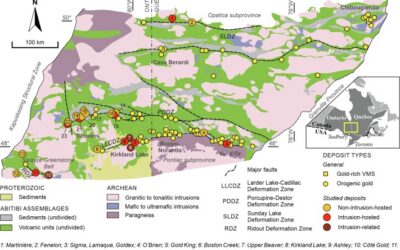
Image Source: https://www.sciencedirect.com/science/article/abs/pii/S016913682100247X The Abitibi Greenstone Belt produced more gold than almost any other Archean terrane on Earth, and the ground is still generating discovery-stage programs across northern Ontario and...
Beyond the Borehole: How 3D Geotechnical Modeling is De-Risking Modern Mine Design
The difference between a viable project and a costly oversight lies in the "digital twin" of the subsurface. Traditional 2D cross-sections, once the industry standard, are no longer sufficient for the complexities of modern resource extraction and the stringent safety...

Starting a Geology Career in Mining and Mineral Exploration
Graduating with a geology degree opens doors, but it can be hard to know which ones to walk through first. Many new graduates want work that's hands-on, technically meaningful, and connected to real projects, but translating that into an actual job search takes some...

Soil Sampling vs. Magnetic vs. Gravity Surveys in Canada’s Covered Terrain
Canada is home to some of the world’s most promising mineral districts, but many of those opportunities lie beneath cover rather than in clean, exposed outcrops. Across much of the country, exploration teams work in terrain shaped by glaciation, transported...

2026 Regulatory Shifts in Geophysics & Geotechnical Reporting in Canada
For Canadian junior and major exploration firms, the "Qualified Person" (QP) is under more scrutiny than ever. As we move into 2026, the integration of geophysical data into NI 43-101 technical reports has evolved from "supplemental" to "essential." In an era of...
How Geophysical Surveys Support Mineral Exploration in Canada’s Remote and Covered Terrains
Canada is one of the most mineral-rich countries in the world, but much of that potential lies in places that are difficult, expensive, or logistically complex to explore. From vast stretches of the Precambrian Shield to sediment-covered basins and northern regions...

Gravity Surveys in Mineral Exploration: How They Work, What They Reveal, and Why They Matter
In mineral exploration, every decision hinges on understanding what lies beneath the surface before drilling begins. Gravity surveys provide a precise, cost-effective way to map subsurface density variations and uncover geological structures that may host valuable...

Why Magnetic and Gravity Surveys Are Essential for Mineral Exploration in Canada
Canada is one of the most geophysically explored countries in the world. With vast mineral potential spread across the Precambrian Shield, structurally complex greenstone belts, sedimentary basins, and remote northern terrains, Canadian exploration has long relied on...