
How Do Geologists Predict Groundwater in Mining and Mineral Exploration?
Geologists predict groundwater by combining geological, geophysical, and hydrological techniques to assess subsurface conditions and water flow. Through these methods, geologists can identify aquifers, estimate water movement, and evaluate how mining activities may interact with underground water systems.
1. Hydrogeological Mapping and Surveys
One of the first steps in predicting groundwater is understanding the geological framework of the mining region. Hydrogeological mapping involves identifying the types of rock formations present and assessing their capacity to store and transmit water.
Aquifer Identification
Geologists begin by identifying aquifers, which are geological formations capable of holding and transmitting groundwater. In mining regions, these aquifers can exist in porous rocks like sandstones or fractured crystalline rocks. Impermeable layers, such as clay or unfractured granite, act as barriers, influencing groundwater flow patterns.
Hydrogeological surveys also include evaluating the recharge areas, where water from precipitation or surface water bodies infiltrates the ground and replenishes the aquifer, as well as discharge areas, where groundwater surfaces as springs or feeds into rivers and lakes. Understanding these dynamics is critical for predicting how groundwater might interact with mining activities, particularly in terms of water inflow into mines or contamination risks from tailings.
2. Geophysical Methods for Subsurface Investigation
To predict groundwater in mining environments, where direct observation of the subsurface is often limited, geologists use several geophysical techniques. These methods offer non-invasive ways to visualize underground conditions and identify potential groundwater-bearing zones.
Seismic Reflection and Refraction
Seismic methods involve sending shock waves into the ground and measuring their reflections or refractions from different subsurface layers. Since water-filled sediments or rock formations have distinct seismic properties compared to dry or solid layers, this method helps detect groundwater reservoirs and estimate their depth.
Electrical Resistivity Tomography (ERT)
Electrical resistivity methods are particularly useful in mapping groundwater in areas with complex geological structures. Water-bearing formations generally have lower resistivity compared to dry rock or clay-rich layers, making ERT an effective tool for identifying aquifers. In mining, ERT can delineate groundwater zones beneath ore bodies or within surrounding rock, assisting in predicting water inflow risks during excavation.
Ground Penetrating Radar (GPR)
GPR sends radar pulses into the ground and measures the reflected signals. This technique is useful for shallow groundwater detection and can help determine the depth to water tables or the extent of saturated zones near the surface. In mining, GPR is often used in tailings management or to monitor groundwater flow near surface operations.
3. Hydraulic Testing
To refine groundwater predictions, geologists conduct hydraulic tests to measure the permeability of the rock and the flow characteristics of the aquifer. In mining and exploration, these tests are essential for understanding how water might behave under extraction activities.
Pumping Tests
Pumping tests involve removing water from a well at a controlled rate and observing the drawdown (reduction in water level) in nearby observation wells. The rate of drawdown and the distance it affects can provide valuable information about the transmissivity and storage capacity of the aquifer. This information is crucial for estimating how much water will flow into a mine during excavation.
Slug and Constant Head Tests
Slug tests involve quickly changing the water level in a well and monitoring the rate of recovery, providing insights into the permeability of the surrounding rock. Constant head tests, where the water level is maintained while monitoring flow rates, offer similar insights. Both tests help assess groundwater flow patterns around mining sites, informing water management strategies and predicting potential dewatering needs during extraction.
4. Groundwater Modeling
Groundwater models are mathematical simulations used to predict how water will move through subsurface formations over time. In the mining industry, these models are vital for assessing water balance, understanding aquifer behavior, and planning dewatering operations.
Numerical Models
Numerical groundwater models simulate complex hydrogeological conditions and groundwater flow using data from geological surveys, geophysical measurements, and hydraulic tests. These models help geologists predict how groundwater will respond to mining activities, such as excavation, pumping, or the placement of tailings. Numerical models also play a role in assessing long-term impacts on the water table and surrounding ecosystems.
Predictive Modeling for Dewatering
In active mining operations, predictive groundwater models inform dewatering plans, which involve removing groundwater from excavation zones to prevent flooding or unstable ground conditions. Geologists use predictive models to estimate how much water will need to be removed, where to place dewatering wells, and how groundwater levels might respond to different mining stages. This is especially important in deep or underground mines where inflow rates can increase as mining progresses.
5. Isotopic and Chemical Tracers
Another method geologists use to predict groundwater behavior involves isotopic and chemical tracing. By analyzing the isotopic composition or chemical makeup of groundwater, geologists can trace its origin, flow paths, and interactions with surrounding rock.
Isotopic Analysis
Stable isotopes of hydrogen and oxygen in water molecules provide clues about groundwater’s recharge source and age. This can help determine if the water originates from recent precipitation or ancient aquifers, which is important in regions where mining operations might disrupt long-standing groundwater systems.
Chemical Tracers
Chemical tracers, such as dissolved salts or elements, offer insights into groundwater flow patterns and the interaction between water and minerals. In mining areas, geologists use tracers to predict the movement of water through ore bodies and surrounding formations, helping to manage risks of water contamination from mining activities.
6. Remote Sensing and Satellite Data
Remote sensing technology, particularly satellite-based methods, is increasingly used in groundwater prediction. In mining, satellite data can monitor changes in surface water bodies, vegetation, and land subsidence, all of which can indicate groundwater depletion or changes in aquifer dynamics.
Satellite Gravity Measurements
Gravity Recovery and Climate Experiment (GRACE) satellite missions provide data on variations in Earth’s gravity field, which can be used to estimate changes in groundwater storage. This technology is especially useful in large-scale mining regions where groundwater depletion needs to be monitored over time.
7. Environmental Impact and Sustainability Considerations
In the context of mining and mineral exploration, groundwater prediction is not solely about water supply. It is also integral to ensuring that mining activities do not adversely affect surrounding water systems or ecosystems. Geologists use groundwater prediction models to plan for:
- Water Conservation: Ensuring that water resources are used efficiently and responsibly during mining operations.
- Contamination Prevention: Predicting and mitigating the risk of groundwater contamination from mining chemicals, tailings, and waste materials.
- Long-term Sustainability: Assessing how mining might alter groundwater systems over time, including potential impacts on nearby communities, agriculture, or natural habitats.
Final Thoughts
Accurate groundwater prediction is essential in the mining and mineral exploration industries, where water plays a critical role in operational safety, environmental management, and resource extraction. Geologists rely on a combination of hydrogeological mapping, geophysical methods, hydraulic testing, groundwater modeling, and isotopic analysis to assess subsurface conditions and predict groundwater behavior.
To optimize your project’s water management strategies and mitigate risks, contact Rangefront’s geophysical experts. Our team is equipped with the expertise and tools necessary to meet your groundwater prediction needs and provide tailored solutions for your mining and mineral exploration operations. Reach out today to discuss how we can assist with your groundwater challenges.

ABOUT THE AUTHOR
BRIAN GOSS
President, Rangefront Mining Services
Brian Goss brings over 20 years of experience in gold and mineral exploration. He is the founder and President of Rangefront, a premier geological services and mining consulting company that caters to a large spectrum of clients in the mining and minerals exploration industries. Brian is also a director of Lithium Corp. (OTCQB: LTUM), an exploration stage company specializing in energy storage minerals and from 2014 to 2017, he fulfilled the role of President and Director of Graphite Corp. (OTCQB: GRPH), an exploration stage that specialized in the development of graphite properties. Prior to founding Rangefront, Brian worked as a staff geologist for Centerra Gold on the REN project, as well as various exploration and development projects in the Western United States and Michigan. Brian Goss holds a Bachelor of Science Degree with a major in Geology from Wayne State University in Michigan.
You may also be interested in...

Annual Claim Renewals Updated for 2026: Mining Claim Maintenance & Assessment Information
Late summer is a critical time for the mining and exploration industry. The deadline for Annual Mining Claim Renewals is September 1, and it arrives fast. Whether you’re a small-scale prospector or managing dozens of claims, it’s essential to ensure your filings,...
Combining Drone and Ground Mag Surveys: More Data, Less Time in the Field
A magnetic survey is only as good as the data density behind it. Two survey platforms, flown and walked over the same ground on the same program, can double that density without doubling your budget or your schedule. That is the logic behind Rangefront's approach to...
Yukon Geophysical Surveys: Season Planning and Field Logistics
The Yukon exploration season is shorter than most project managers account for, and the margin for a poorly timed mobilization is close to zero. Between spring break-up, permafrost thaw cycles, and the onset of fall freeze, the usable field window for most ground...
How to Read an IP Pseudosection: Interpreting Chargeability and Resistivity Anomalies Before You Drill
A chargeability anomaly that looks like a porphyry target and turns out to be graphitic shale is a wasted drill hole, a budget hit, and a credibility problem in front of your board. Reading an IP pseudosection correctly before the rig mobilizes is one of the...
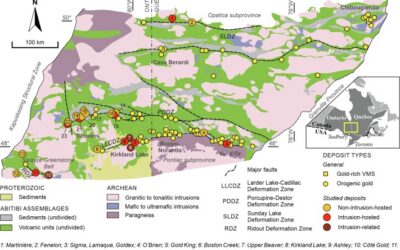
Mineral Exploration in the Abitibi Greenstone Belt: Geology, Deposit Types, and What to Expect in the Field
Image Source: https://www.sciencedirect.com/science/article/abs/pii/S016913682100247X The Abitibi Greenstone Belt produced more gold than almost any other Archean terrane on Earth, and the ground is still generating discovery-stage programs across northern Ontario and...
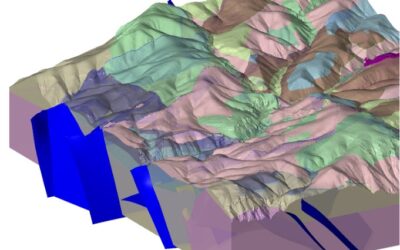
Beyond the Borehole: How 3D Geotechnical Modeling is De-Risking Modern Mine Design
The difference between a viable project and a costly oversight lies in the "digital twin" of the subsurface. Traditional 2D cross-sections, once the industry standard, are no longer sufficient for the complexities of modern resource extraction and the stringent safety...
Starting a Geology Career in Mining and Mineral Exploration
Graduating with a geology degree opens doors, but it can be hard to know which ones to walk through first. Many new graduates want work that's hands-on, technically meaningful, and connected to real projects, but translating that into an actual job search takes some...
Soil Sampling vs. Magnetic vs. Gravity Surveys in Canada’s Covered Terrain
Canada is home to some of the world’s most promising mineral districts, but many of those opportunities lie beneath cover rather than in clean, exposed outcrops. Across much of the country, exploration teams work in terrain shaped by glaciation, transported...

2026 Regulatory Shifts in Geophysics & Geotechnical Reporting in Canada
For Canadian junior and major exploration firms, the "Qualified Person" (QP) is under more scrutiny than ever. As we move into 2026, the integration of geophysical data into NI 43-101 technical reports has evolved from "supplemental" to "essential." In an era of...
How Geophysical Surveys Support Mineral Exploration in Canada’s Remote and Covered Terrains
Canada is one of the most mineral-rich countries in the world, but much of that potential lies in places that are difficult, expensive, or logistically complex to explore. From vast stretches of the Precambrian Shield to sediment-covered basins and northern regions...

Gravity Surveys in Mineral Exploration: How They Work, What They Reveal, and Why They Matter
In mineral exploration, every decision hinges on understanding what lies beneath the surface before drilling begins. Gravity surveys provide a precise, cost-effective way to map subsurface density variations and uncover geological structures that may host valuable...

Why Magnetic and Gravity Surveys Are Essential for Mineral Exploration in Canada
Canada is one of the most geophysically explored countries in the world. With vast mineral potential spread across the Precambrian Shield, structurally complex greenstone belts, sedimentary basins, and remote northern terrains, Canadian exploration has long relied on...