
In the mining industry, geologists are essential for identifying and extracting mineral resources that are fundamental to global economies. They conduct exploratory surveys, analyze geological data, and assess the quality and quantity of mineral deposits to ensure efficient and cost-effective mining operations. Beyond discovery, mining geologists are involved in the planning, development, and environmental management of mining sites, ensuring that operations are both profitable and compliant with environmental regulations. Their contributions help meet the world’s demand for raw materials while balancing the need for sustainable practices, making geology a critical field within mining.
Top-Paying Careers in Geology
Pay for geology jobs ranges with certain specializations commanding significantly higher salaries. This disparity is influenced by industry demand, the complexity of the tasks involved, and the specialized knowledge required. Below, we explore the highest-paying careers in geology, the industries that drive their earnings, and the advanced skills that set these professionals apart.
1. Petroleum Geologists
Petroleum geologists are among the highest-paid professionals in the geosciences due to their vital role in the oil and gas industry. These specialists use their expertise to locate, assess, and develop oil and gas reserves, which remain critical sources of global energy.
The high salaries of petroleum geologists are driven by the scale of the oil and gas industry. The discovery of a new reservoir can lead to multi-billion-dollar projects, and the precision of geological assessments can significantly impact the success of these endeavors. In regions rich in oil and gas, such as the Middle East, Texas, and Alaska, experienced petroleum geologists can earn six-figure salaries. Those with advanced degrees or specialized expertise in areas such as offshore drilling or deep-water exploration may earn even more.
The outlook for petroleum geologists remains positive, though it is shaped by both industry trends and the global shift towards renewable energy. While demand for fossil fuels continues to drive job opportunities, the rise of renewable energy sources is gradually influencing long-term employment prospects. Nevertheless, petroleum geologists with expertise in advanced exploration techniques, such as deep-water drilling or unconventional resources like shale, are in high demand. Additionally, as global energy markets fluctuate, petroleum geologists who adapt to emerging technologies and contribute to more efficient, environmentally conscious extraction methods are well-positioned to maintain relevance and command competitive salaries in the energy sector.
Key Responsibilities
Petroleum geologists analyze geological data, including seismic surveys, well logs, and rock samples, to identify potential oil and gas reservoirs. They work closely with engineers and other specialists to determine the viability of extraction projects, balancing factors like cost, environmental impact, and technological feasibility.
Skills and Education
A bachelor’s degree in geology or geophysics is the minimum requirement for entry-level positions, but a master’s or Ph.D. can lead to more senior roles and higher pay. Skills in seismic interpretation, basin modeling, and reservoir characterization are highly valued, as is proficiency in software tools like Petrel or Kingdom Suite.
2. Mining Geologists
Mining geologists play a crucial role in the discovery and extraction of mineral resources, including precious metals, base metals, and industrial minerals. This specialization is particularly lucrative in regions rich in natural resources, such as Canada, Australia, and parts of Africa and South America.
The mining industry is capital-intensive, and the decisions made by geologists can have a significant financial impact. Accurate assessments of mineral reserves and ore quality can make the difference between a profitable mine and a financial failure. As a result, experienced mining geologists with a track record of success are in high demand and can command salaries that reflect their expertise. Geologists working in remote or hazardous locations, such as Arctic mines or deep underground operations, often receive additional compensation for the risks involved.
Key Responsibilities
Mining geologists conduct exploratory surveys to locate mineral deposits, analyze geological data, and assess the potential profitability of mining operations. Once a site is selected, they oversee the extraction process, ensuring that it is both efficient and environmentally responsible. They also play a critical role in mine planning and development, working to maximize resource recovery while minimizing costs and environmental impacts.
Skills and Education
A bachelor’s degree in geology or mining engineering is typically required, but a master’s degree can open doors to higher-paying positions. Skills in resource estimation, geostatistics, and mineralogy are essential, as is familiarity with software tools like Surpac or Leapfrog. Geologists with expertise in specific commodities, such as gold or lithium, may find particularly lucrative opportunities as demand for these materials grows.
3. Engineering Geologists
Engineering geologists play a critical role in large-scale civil engineering projects, such as the construction of dams, tunnels, highways, and buildings. They ensure that these structures are built on solid geological foundations, minimizing the risk of failures or accidents.
The importance of their work in ensuring the stability and safety of multi-million-dollar infrastructure projects makes engineering geologists highly valued professionals. Geologists who specialize in high-risk environments, such as seismic zones or areas prone to subsidence, are particularly sought after and can command premium salaries.
Key Responsibilities
Engineering geologists assess the suitability of sites for construction by analyzing soil, rock, and groundwater conditions. They provide recommendations on how to mitigate geological risks, such as landslides, sinkholes, or earthquakes. Their work is essential to ensuring the safety and longevity of infrastructure projects.
Skills and Education
A bachelor’s degree in geology or civil engineering is usually required, and many engineering geologists also pursue certifications in geotechnical engineering or geological engineering. Skills in geotechnical analysis, risk assessment, and foundation design are critical, as is proficiency with software tools like GeoStudio or Rocscience.
4. Hydrogeologists
Hydrogeologists focus on the study and management of groundwater, a vital resource for industries such as agriculture, mining, and urban development. Their expertise is essential in regions where water scarcity is a significant concern or where groundwater contamination poses a risk to public health.
Hydrogeologists working in industries like mining, oil and gas, or environmental consulting can earn high salaries due to the importance of water management in these sectors. The complexity of groundwater systems, combined with the potential environmental and legal consequences of mismanagement, makes experienced hydrogeologists highly valuable. Those working in arid regions or areas facing water scarcity challenges often receive additional compensation for their expertise. View hydrogeology job openings here.
Key Responsibilities
Hydrogeologists assess groundwater availability, quality, and flow patterns to support sustainable water management. They design and oversee groundwater extraction systems, evaluate the impact of industrial activities on water resources, and develop strategies to prevent or remediate groundwater contamination.
Skills and Education
A bachelor’s degree in geology or hydrogeology is required, but a master’s or Ph.D. is often necessary for advanced positions. Key skills include groundwater modeling, aquifer analysis, and contaminant transport assessment. Proficiency with tools like MODFLOW or GMS is highly valued.
5. Geophysicists
Geophysicists, a specialized subset of geologists, study the physical properties of the Earth to locate natural resources, assess geological hazards, and support environmental monitoring. Their work is particularly valuable in the oil and gas industry, where they use seismic data to locate hydrocarbon reserves.
The technical expertise required to interpret geophysical data, combined with the high stakes of resource exploration, makes geophysicists some of the highest-paid professionals in geology. Those working in seismic interpretation or exploration geophysics, especially in the oil and gas industry, can earn substantial salaries.
Key Responsibilities
Geophysicists use a variety of techniques, including seismic, magnetic, and gravitational surveys, to study the Earth’s subsurface. They analyze these data to create models that guide exploration efforts in the oil, gas, and mining industries.
Skills and Education
A bachelor’s degree in geophysics or geology is required, but a master’s degree is often necessary for more advanced roles. Key skills include seismic interpretation, geophysical data analysis, and proficiency with software like Petrel or Geosoft.
Final Thoughts
Geologists play a vital role in a wide range of industries, from energy to infrastructure to environmental management. While all geologists contribute to our understanding and management of Earth’s resources, those with specialized skills in high-demand industries like oil and gas, mining, and engineering can command the highest salaries.
Are you interested in a geological job in the mining industry? View job openings by clicking the button below.

ABOUT THE AUTHOR
BRIAN GOSS
President, Rangefront Mining Services
Brian Goss brings over 20 years of experience in gold and mineral exploration. He is the founder and President of Rangefront, a premier geological services and mining consulting company that caters to a large spectrum of clients in the mining and minerals exploration industries. Brian is also a director of Lithium Corp. (OTCQB: LTUM), an exploration stage company specializing in energy storage minerals and from 2014 to 2017, he fulfilled the role of President and Director of Graphite Corp. (OTCQB: GRPH), an exploration stage that specialized in the development of graphite properties. Prior to founding Rangefront, Brian worked as a staff geologist for Centerra Gold on the REN project, as well as various exploration and development projects in the Western United States and Michigan. Brian Goss holds a Bachelor of Science Degree with a major in Geology from Wayne State University in Michigan.
You may also be interested in...

Annual Claim Renewals Updated for 2026: Mining Claim Maintenance & Assessment Information
Late summer is a critical time for the mining and exploration industry. The deadline for Annual Mining Claim Renewals is September 1, and it arrives fast. Whether you’re a small-scale prospector or managing dozens of claims, it’s essential to ensure your filings,...
Combining Drone and Ground Mag Surveys: More Data, Less Time in the Field
A magnetic survey is only as good as the data density behind it. Two survey platforms, flown and walked over the same ground on the same program, can double that density without doubling your budget or your schedule. That is the logic behind Rangefront's approach to...
Yukon Geophysical Surveys: Season Planning and Field Logistics
The Yukon exploration season is shorter than most project managers account for, and the margin for a poorly timed mobilization is close to zero. Between spring break-up, permafrost thaw cycles, and the onset of fall freeze, the usable field window for most ground...
How to Read an IP Pseudosection: Interpreting Chargeability and Resistivity Anomalies Before You Drill
A chargeability anomaly that looks like a porphyry target and turns out to be graphitic shale is a wasted drill hole, a budget hit, and a credibility problem in front of your board. Reading an IP pseudosection correctly before the rig mobilizes is one of the...
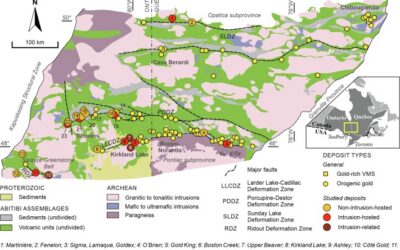
Mineral Exploration in the Abitibi Greenstone Belt: Geology, Deposit Types, and What to Expect in the Field
Image Source: https://www.sciencedirect.com/science/article/abs/pii/S016913682100247X The Abitibi Greenstone Belt produced more gold than almost any other Archean terrane on Earth, and the ground is still generating discovery-stage programs across northern Ontario and...
Beyond the Borehole: How 3D Geotechnical Modeling is De-Risking Modern Mine Design
The difference between a viable project and a costly oversight lies in the "digital twin" of the subsurface. Traditional 2D cross-sections, once the industry standard, are no longer sufficient for the complexities of modern resource extraction and the stringent safety...

Starting a Geology Career in Mining and Mineral Exploration
Graduating with a geology degree opens doors, but it can be hard to know which ones to walk through first. Many new graduates want work that's hands-on, technically meaningful, and connected to real projects, but translating that into an actual job search takes some...

Soil Sampling vs. Magnetic vs. Gravity Surveys in Canada’s Covered Terrain
Canada is home to some of the world’s most promising mineral districts, but many of those opportunities lie beneath cover rather than in clean, exposed outcrops. Across much of the country, exploration teams work in terrain shaped by glaciation, transported...

2026 Regulatory Shifts in Geophysics & Geotechnical Reporting in Canada
For Canadian junior and major exploration firms, the "Qualified Person" (QP) is under more scrutiny than ever. As we move into 2026, the integration of geophysical data into NI 43-101 technical reports has evolved from "supplemental" to "essential." In an era of...
How Geophysical Surveys Support Mineral Exploration in Canada’s Remote and Covered Terrains
Canada is one of the most mineral-rich countries in the world, but much of that potential lies in places that are difficult, expensive, or logistically complex to explore. From vast stretches of the Precambrian Shield to sediment-covered basins and northern regions...

Gravity Surveys in Mineral Exploration: How They Work, What They Reveal, and Why They Matter
In mineral exploration, every decision hinges on understanding what lies beneath the surface before drilling begins. Gravity surveys provide a precise, cost-effective way to map subsurface density variations and uncover geological structures that may host valuable...

Why Magnetic and Gravity Surveys Are Essential for Mineral Exploration in Canada
Canada is one of the most geophysically explored countries in the world. With vast mineral potential spread across the Precambrian Shield, structurally complex greenstone belts, sedimentary basins, and remote northern terrains, Canadian exploration has long relied on...