
Geophysical survey techniques are important tools in mining geology, enabling the exploration and evaluation of mineral resources beneath the Earth’s surface. With advances in technology, these geophysical survey methods have become increasingly sophisticated, offering precise and cost-effective solutions for mineral exploration. Here, we explore the top five geophysical survey techniques, their methodologies, and the scenarios where they are most effectively applied.
Top Geophysical Surveys for Mining Geology
Geophysical surveys are essential for mining geology because they provide critical insights into the Earth’s subsurface, enabling the efficient identification and evaluation of mineral resources. By employing advanced techniques such as seismic, magnetic, electromagnetic, gravity, and induced polarization surveys, geologists can map geological structures, locate ore deposits, and assess the feasibility of mining projects. These methods reduce the need for invasive and costly drilling, minimizing environmental impact while streamlining exploration efforts. Geophysical surveys also improve the accuracy of resource estimation, helping mining companies allocate resources effectively and avoid unnecessary expenditures.
In addition, geophysical surveys are vital for addressing the complexities of modern mineral exploration, particularly as easily accessible deposits are depleted and exploration shifts to deeper or more remote locations. They play a pivotal role in identifying concealed ore bodies and understanding the geological context of mineralized zones. By integrating data from multiple survey methods, geologists can create detailed 3D geological models of subsurface conditions, aiding in the development of sustainable mining strategies. This level of precision not only enhances resource discovery but also supports compliance with environmental regulations and reduces the risks associated with mining operations.
1. Seismic Reflection and Refraction Surveys
Seismic techniques rely on analyzing the propagation of seismic waves through subsurface materials. These methods are classified into two primary types: seismic reflection and seismic refraction.
How It Works
- Seismic Reflection: Measures the time it takes for seismic waves, generated by controlled explosions or vibrating sources, to bounce off subsurface layers and return to surface sensors.
- Seismic Refraction: Captures waves that bend as they travel through materials with different velocities, revealing the layers’ properties and depths.
Applications in Mining
- Reflection: Ideal for mapping complex geological structures, such as faults and folds, in areas with deep mineral deposits.
- Refraction: Best suited for delineating shallow subsurface structures and identifying ore bodies in simpler geological settings.
Advantages
- High-resolution imaging of subsurface layers.
- Effective for identifying structural traps that may host minerals.
Limitations
- Can be more expensive and time-intensive compared to other methods.
- Requires skilled interpretation of data.
2. Magnetic Surveys
Magnetic surveys measure variations in the Earth’s magnetic field caused by subsurface rocks containing magnetic minerals like magnetite or hematite.
How It Works
- Conducted using magnetometers mounted on aircraft, drones, or carried by ground crews.
- Records magnetic anomalies indicative of mineralized zones.
Applications in Mining
- Locating iron ore deposits, which are inherently magnetic.
- Detecting structures such as dykes and faults that influence mineral deposition.
Advantages
- Rapid and cost-effective, especially for large areas.
- Non-invasive and adaptable to aerial or ground deployment.
Limitations
- Limited effectiveness in areas with weak magnetic contrasts.
- Cannot directly identify non-magnetic minerals.
3. Electromagnetic (EM) Surveys
Electromagnetic surveys exploit the conductive properties of subsurface materials. Variations in electrical conductivity can indicate mineralized zones.
How It Works
- A transmitter generates an electromagnetic field that induces currents in the subsurface.
- Secondary fields created by these currents are detected by receivers to infer conductivity contrasts.
Applications in Mining
- Detection of base metal sulfides (e.g., copper, nickel, and zinc), which are highly conductive.
- Mapping of groundwater, often associated with ore-forming processes.
Advantages
- Highly effective for identifying conductive mineral deposits.
- Can cover large areas quickly when deployed aerially.
Limitations
- Limited penetration depth in areas with highly resistive overburden.
- High noise levels in urban or industrial settings.
4. Gravity Surveys
Gravity surveys measure variations in the Earth’s gravitational field caused by density contrasts in subsurface materials. Denser rocks create stronger gravitational anomalies.
How It Works
- Gravimeters record minute changes in gravitational acceleration.
- Anomalies are mapped to infer subsurface density distributions.
Applications in Mining
- Identification of dense ore bodies, such as massive sulfide deposits or chromite.
- Mapping large-scale geological structures, such as basins and faults.
Advantages
- Non-invasive and environmentally friendly.
- Effective for deep exploration in areas with limited geological exposure.
Limitations
- Poor resolution for small or shallow deposits.
- Requires corrections for topographic and environmental effects, adding complexity.
5. Induced Polarization (IP) Surveys
Induced polarization is a powerful technique for detecting disseminated sulfide minerals and other conductive materials in the subsurface.
How It Works
- Electrodes inject current into the ground, and the decay of voltage over time is measured.
- The rate of decay provides insights into the chargeability and resistivity of subsurface materials.
Applications in Mining
- Locating disseminated sulfide deposits, such as porphyry copper and gold systems.
- Identifying alteration zones associated with hydrothermal mineralization.
Advantages
- High sensitivity to disseminated mineralization.
- Can detect low-concentration ore deposits.
Limitations
- Slower and more labor-intensive compared to other methods.
- Results can be affected by surface noise and require careful interpretation.
Choosing the Right Geophysical Techniques
The selection of a geophysical survey method depends on several factors, including the type of deposit, depth of the target, and geological setting. Combining multiple techniques often provides the most comprehensive understanding.
Scenario 1: Shallow Exploration
- Use magnetic surveys for quick and cost-effective mapping of iron-rich deposits.
- Employ gravity surveys to identify dense ore bodies.
Scenario 2: Deep Exploration
- Opt for seismic reflection surveys to map complex subsurface structures.
- Combine with IP surveys to pinpoint disseminated mineralization at depth.
Scenario 3: Base Metal Exploration
- Electromagnetic surveys excel in detecting highly conductive sulfide ores.
- IP surveys complement EM by providing chargeability data.
Scenario 4: Greenfield Exploration
- Begin with magnetic and gravity surveys to delineate broad geological features.
- Follow up with targeted seismic or IP surveys for detailed analysis.
Integrating Geophysical Data
Modern mining projects increasingly rely on integrated geophysical data to enhance exploration success. Advanced modeling and visualization tools enable geologists to combine datasets from multiple techniques, improving accuracy and reducing uncertainty.
Example: 3D Modeling
- Combine magnetic, gravity, and seismic data to build detailed 3D geological models.
- Use models to identify drill targets, reducing the costs and risks associated with exploration.
Challenges and Innovations
Despite their advantages, geophysical surveys face challenges such as:
- Data noise from human activities or natural sources.
- High costs for advanced techniques like seismic surveys.
Innovations like machine learning and AI are revolutionizing geophysical data processing, enabling faster and more accurate interpretations. Additionally, the development of portable and drone-mounted equipment is expanding access to remote and challenging terrains.
Final Thoughts
Geophysical survey techniques are a key part of modern mining geology, providing invaluable insights into the Earth’s subsurface. By understanding the strengths and limitations of each method, mining professionals can design exploration programs tailored to their specific needs. Whether mapping iron ore with magnetic surveys or uncovering deep sulfide deposits with IP surveys, these tools are essential for efficient and sustainable mineral exploration.

ABOUT THE AUTHOR
BRIAN GOSS
President, Rangefront Mining Services
Brian Goss brings over 20 years of experience in gold and mineral exploration. He is the founder and President of Rangefront, a premier geological services and mining consulting company that caters to a large spectrum of clients in the mining and minerals exploration industries. Brian is also a director of Lithium Corp. (OTCQB: LTUM), an exploration stage company specializing in energy storage minerals and from 2014 to 2017, he fulfilled the role of President and Director of Graphite Corp. (OTCQB: GRPH), an exploration stage that specialized in the development of graphite properties. Prior to founding Rangefront, Brian worked as a staff geologist for Centerra Gold on the REN project, as well as various exploration and development projects in the Western United States and Michigan. Brian Goss holds a Bachelor of Science Degree with a major in Geology from Wayne State University in Michigan.
You may also be interested in...

Annual Claim Renewals Updated for 2026: Mining Claim Maintenance & Assessment Information
Late summer is a critical time for the mining and exploration industry. The deadline for Annual Mining Claim Renewals is September 1, and it arrives fast. Whether you’re a small-scale prospector or managing dozens of claims, it’s essential to ensure your filings,...
Combining Drone and Ground Mag Surveys: More Data, Less Time in the Field
A magnetic survey is only as good as the data density behind it. Two survey platforms, flown and walked over the same ground on the same program, can double that density without doubling your budget or your schedule. That is the logic behind Rangefront's approach to...
Yukon Geophysical Surveys: Season Planning and Field Logistics
The Yukon exploration season is shorter than most project managers account for, and the margin for a poorly timed mobilization is close to zero. Between spring break-up, permafrost thaw cycles, and the onset of fall freeze, the usable field window for most ground...
How to Read an IP Pseudosection: Interpreting Chargeability and Resistivity Anomalies Before You Drill
A chargeability anomaly that looks like a porphyry target and turns out to be graphitic shale is a wasted drill hole, a budget hit, and a credibility problem in front of your board. Reading an IP pseudosection correctly before the rig mobilizes is one of the...
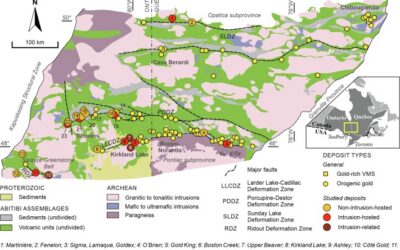
Mineral Exploration in the Abitibi Greenstone Belt: Geology, Deposit Types, and What to Expect in the Field
Image Source: https://www.sciencedirect.com/science/article/abs/pii/S016913682100247X The Abitibi Greenstone Belt produced more gold than almost any other Archean terrane on Earth, and the ground is still generating discovery-stage programs across northern Ontario and...
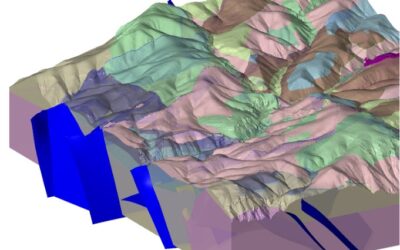
Beyond the Borehole: How 3D Geotechnical Modeling is De-Risking Modern Mine Design
The difference between a viable project and a costly oversight lies in the "digital twin" of the subsurface. Traditional 2D cross-sections, once the industry standard, are no longer sufficient for the complexities of modern resource extraction and the stringent safety...

Starting a Geology Career in Mining and Mineral Exploration
Graduating with a geology degree opens doors, but it can be hard to know which ones to walk through first. Many new graduates want work that's hands-on, technically meaningful, and connected to real projects, but translating that into an actual job search takes some...

Soil Sampling vs. Magnetic vs. Gravity Surveys in Canada’s Covered Terrain
Canada is home to some of the world’s most promising mineral districts, but many of those opportunities lie beneath cover rather than in clean, exposed outcrops. Across much of the country, exploration teams work in terrain shaped by glaciation, transported...

2026 Regulatory Shifts in Geophysics & Geotechnical Reporting in Canada
For Canadian junior and major exploration firms, the "Qualified Person" (QP) is under more scrutiny than ever. As we move into 2026, the integration of geophysical data into NI 43-101 technical reports has evolved from "supplemental" to "essential." In an era of...
How Geophysical Surveys Support Mineral Exploration in Canada’s Remote and Covered Terrains
Canada is one of the most mineral-rich countries in the world, but much of that potential lies in places that are difficult, expensive, or logistically complex to explore. From vast stretches of the Precambrian Shield to sediment-covered basins and northern regions...

Gravity Surveys in Mineral Exploration: How They Work, What They Reveal, and Why They Matter
In mineral exploration, every decision hinges on understanding what lies beneath the surface before drilling begins. Gravity surveys provide a precise, cost-effective way to map subsurface density variations and uncover geological structures that may host valuable...

Why Magnetic and Gravity Surveys Are Essential for Mineral Exploration in Canada
Canada is one of the most geophysically explored countries in the world. With vast mineral potential spread across the Precambrian Shield, structurally complex greenstone belts, sedimentary basins, and remote northern terrains, Canadian exploration has long relied on...