
Utilizing a mining consultant during the mining and exploration process is an integral part of most operations’ strategies. As well as maximizing value and operational performance, a mining consultant can help shape strategy, drive innovation, and mitigate risks from health and safety to governmental compliance and more.
In this article, we discuss some of the common challenges mining consultants help resolve.
TOP SERVICES PROVIDED BY MINING CONSULTANTS
Some mining operations will seek a mining consultant who specializes in an area of need for a specific mining project. For many other operations, a mining consultant “group” or service will be used that has comprehensive expertise in the wide range of mining operations and can assist in any challenge the project faces. Some of these challenges may include:
PROJECT EFFICIENCY
A primary purpose of mining consultants is to help ensure the project runs as smoothly and profitably as possible. This comes down to project efficiency. A skilled mining consultant will look at current operations, at whatever stage they may be in, and determine a more efficient, profitable, and successful path forward. The benefit of having a mining consultant in this case is being able. To draw upon their years of experience in a wide range of projects and with countless challenges and opportunities—and solutions.
RESOURCE MODELING
Many mining consultants or consulting teams are especially proficient in resource modeling and optimization. With the consultant’s expertise, you can better set—and meet—resource, exploration, and profitability goals. A mining consultant will use geophysical tools and surveys to create a clear picture of your potential resources, then use these detailed reports in conjunction with expertise to devise the highest-success and highest-profitability plan possible.
ENGINEERING & DESIGN
Mining consultants can be invaluable during the design and engineering process of a mine. This additional level of expertise can help to save costs, reduce risks, and provide strategy and insight that can increase the mine’s performance. Consultants can also help to coordinate, manage, and implement mid-project solutions to improve mine efficiency and growth.
OPPORTUNITY MANAGEMENT
There’s no doubt that challenges will arise mid-project, but so, too, will opportunities. A consultant can help analyze these opportunities using feasibility, risk management, and trade-off studies to determine whether to pursue certain opportunities, and if so, how to do so as successfully as possible.
RISK MANAGEMENT
Mining is a risky business. Although mining only employs 1% of the workforce, it is responsible for 8% of workforce casualties. The risks in a mine vary from collapses to toxic gasses to extreme temperature and poor air quality. There’s little that gives an operation worse PR than a fatal accident. Mining consultants help to analyze existing or prospective operations to help mitigate potential risks.
SAFETY IMPROVEMENT
Similar to the above challenge, there are cases where safety concerns arise. Utilizing a mining consultant in the case of safety concerns helps to put an effective solution in place for the most reasonable cost. Solutions can easily become outdated, mismanaged, or can have budgetary implications. A mining consultant can take a look at the full picture, ensuring the implementation of the most reasonable solution for the risk, budget, protocols, and regulations.
DUE DILIGENCE
Another beneficial service provided by mining consultants is due diligence. Mining activities have a lot of moving parts from transportation to permitting, infrastructure to financial, and more. An expert mining consultant has expertise in due diligence to help reduce risk and optimize the probability of success.
STAFFING
Staffing is a huge part of a mining operation’s success or failure. You must have the right people on your team to get the right information and production. A mining consultant will have the knowledge and tools to help you know what kind of staffing you need, and how to fill those needs in the most efficient and sensible way possible.
ENVIRONMENTAL RESPONSIBILITY
The environmental responsibilities of the mining industry have come more into the forefront of social and political causes across the globe. Movements to protect natural water bodies, preserve ecologically and culturally significant areas, establish environmental protections, and more are included in reports such as the “Framework for Responsible Mining: A Guide to Evolving Standards” by the Center for Science in the Public Interest and the World Resources Institute, the Responsible Mining Foundation (RMF), as well as agreements, such as the Rio Declaration, Sustainable Development Goals (SDGs), the Environmental Protection Act (EPA), and more.
CORPORATE SOCIAL RESPONSIBILITY
As well as environmental responsibility, a mining consultant can assist in social responsibility as well as improving relationships with the surrounding communities. Mining activities are often criticized for their impact on workers’ health and for local communities who see mining as a threat to their society, environment, community, and/or economy. A mining consultant can assist in the implementation of corporate social responsibility research, strategy, and implementation as well as public relations efforts to improve stakeholder relationship management.
GOVERNMENTAL COMPLIANCE
The mining industry comes with a range of compliance requirements, including compliance regarding environmental protections, labor and mine safety, health administration, reclamation and enforcement, and more. A mining consultant will help navigate governmental compliance for the project’s specific location, ore, and stage of activity, ensuring all “i’s are dotted and t’s are crossed” to mitigate future regulatory issues.
CLOSURE & RECLAMATION
Mine closure and reclamation efforts differ based on where the land is located, the history of the mine, ecological impact of a mine closure, etc. It typically includes efforts including removing toxic materials, machinery, and mining structures; filling holes and closing off tunnels; fencing dangerous areas; implementing signage to warm of additional dangers, etc. A mining consultant will help determine the best closure and reclamation process as well as providing the resources to implement this process as effectively as possible.
Ask a Question
Would you like to learn more about mining consultants and their work in the mining industry? Let us know in the comments below or by contacting us today.

ABOUT THE AUTHOR
BRIAN GOSS
President, Rangefront Mining Services
Brian Goss brings over 20 years of experience in gold and mineral exploration. He is the founder and President of Rangefront, a premier geological services and mining consulting company that caters to a large spectrum of clients in the mining and minerals exploration industries. Brian is also a director of Lithium Corp. (OTCQB: LTUM), an exploration stage company specializing in energy storage minerals and from 2014 to 2017, he fulfilled the role of President and Director of Graphite Corp. (OTCQB: GRPH), an exploration stage that specialized in the development of graphite properties. Prior to founding Rangefront, Brian worked as a staff geologist for Centerra Gold on the REN project, as well as various exploration and development projects in the Western United States and Michigan. Brian Goss holds a Bachelor of Science Degree with a major in Geology from Wayne State University in Michigan.
You may also be interested in...

Annual Claim Renewals Updated for 2026: Mining Claim Maintenance & Assessment Information
Late summer is a critical time for the mining and exploration industry. The deadline for Annual Mining Claim Renewals is September 1, and it arrives fast. Whether you’re a small-scale prospector or managing dozens of claims, it’s essential to ensure your filings,...
Combining Drone and Ground Mag Surveys: More Data, Less Time in the Field
A magnetic survey is only as good as the data density behind it. Two survey platforms, flown and walked over the same ground on the same program, can double that density without doubling your budget or your schedule. That is the logic behind Rangefront's approach to...
Yukon Geophysical Surveys: Season Planning and Field Logistics
The Yukon exploration season is shorter than most project managers account for, and the margin for a poorly timed mobilization is close to zero. Between spring break-up, permafrost thaw cycles, and the onset of fall freeze, the usable field window for most ground...
How to Read an IP Pseudosection: Interpreting Chargeability and Resistivity Anomalies Before You Drill
A chargeability anomaly that looks like a porphyry target and turns out to be graphitic shale is a wasted drill hole, a budget hit, and a credibility problem in front of your board. Reading an IP pseudosection correctly before the rig mobilizes is one of the...
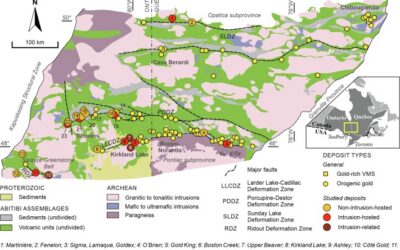
Mineral Exploration in the Abitibi Greenstone Belt: Geology, Deposit Types, and What to Expect in the Field
Image Source: https://www.sciencedirect.com/science/article/abs/pii/S016913682100247X The Abitibi Greenstone Belt produced more gold than almost any other Archean terrane on Earth, and the ground is still generating discovery-stage programs across northern Ontario and...
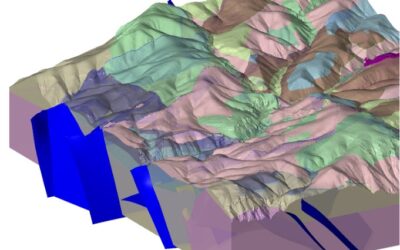
Beyond the Borehole: How 3D Geotechnical Modeling is De-Risking Modern Mine Design
The difference between a viable project and a costly oversight lies in the "digital twin" of the subsurface. Traditional 2D cross-sections, once the industry standard, are no longer sufficient for the complexities of modern resource extraction and the stringent safety...

Starting a Geology Career in Mining and Mineral Exploration
Graduating with a geology degree opens doors, but it can be hard to know which ones to walk through first. Many new graduates want work that's hands-on, technically meaningful, and connected to real projects, but translating that into an actual job search takes some...

Soil Sampling vs. Magnetic vs. Gravity Surveys in Canada’s Covered Terrain
Canada is home to some of the world’s most promising mineral districts, but many of those opportunities lie beneath cover rather than in clean, exposed outcrops. Across much of the country, exploration teams work in terrain shaped by glaciation, transported...

2026 Regulatory Shifts in Geophysics & Geotechnical Reporting in Canada
For Canadian junior and major exploration firms, the "Qualified Person" (QP) is under more scrutiny than ever. As we move into 2026, the integration of geophysical data into NI 43-101 technical reports has evolved from "supplemental" to "essential." In an era of...
How Geophysical Surveys Support Mineral Exploration in Canada’s Remote and Covered Terrains
Canada is one of the most mineral-rich countries in the world, but much of that potential lies in places that are difficult, expensive, or logistically complex to explore. From vast stretches of the Precambrian Shield to sediment-covered basins and northern regions...

Gravity Surveys in Mineral Exploration: How They Work, What They Reveal, and Why They Matter
In mineral exploration, every decision hinges on understanding what lies beneath the surface before drilling begins. Gravity surveys provide a precise, cost-effective way to map subsurface density variations and uncover geological structures that may host valuable...

Why Magnetic and Gravity Surveys Are Essential for Mineral Exploration in Canada
Canada is one of the most geophysically explored countries in the world. With vast mineral potential spread across the Precambrian Shield, structurally complex greenstone belts, sedimentary basins, and remote northern terrains, Canadian exploration has long relied on...