
In early 2025, the Canadian mining and exploration industry found itself at the epicenter of escalating trade tensions between Canada and the United States. The imposition of substantial tariffs by the U.S. government has prompted a multifaceted response from Canadian stakeholders, aiming to mitigate immediate impacts while strategizing for long-term resilience.
The Tariff Landscape
On February 1, 2025, U.S. President Donald Trump invoked the International Emergency Economic Powers Act (IEEPA) to declare a national emergency, leading to the imposition of a 25% tariff on all Canadian imports, with a specific 10% tariff on energy resources, including critical minerals (White House, 2025). These measures were justified by the U.S. administration as necessary to address trade imbalances and protect national security interests.
The tariffs have significantly disrupted the longstanding trade relationship between the two nations. Given that over half of Canada’s mineral production has traditionally been exported to the U.S., the new tariffs have introduced substantial cost pressures and market uncertainties for Canadian mining companies (TPD, 2025).
Economic Implications of U.S. Tariffs in Canada
The immediate economic ramifications of the U.S. tariffs are profound. Analysts predict that the Canadian economy could experience a GDP contraction of up to 2.5% by early 2026, with inflation rates potentially exceeding 7% by mid-2025 (Wikipedia, 2025). The mining sector, a significant contributor to Canada’s GDP, faces increased production costs and potential job losses, exacerbating the economic strain.
The Bank of Canada has acknowledged the heightened economic uncertainty, maintaining its overnight policy rate at 2.75% while monitoring the evolving trade situation (Reuters, 2025).
Industry Responses and Strategic Shifts
In response to the tariffs, Canadian mining companies are actively seeking alternative markets to offset the loss of U.S. demand. Teck Resources, for instance, has announced plans to redirect its zinc exports to Asian markets, leveraging existing warehousing and port facilities to facilitate this transition (Reuters, 2025).
Investors are also adjusting their portfolios, with increased interest in gold and uranium stocks, viewed as safer assets amidst the trade turmoil. Companies like Cameco Corp have seen a surge in investment due to their critical role in energy production and the relative insulation of uranium from tariff impacts (Reuters, 2025).
Government Initiatives and Policy Measures
The Canadian government has implemented several measures to support the mining sector during this challenging period. Notably, the Mineral Exploration Tax Credit (METC), which offers a 15% tax credit to investors in flow-through shares of junior mining companies, has been extended for two additional years, now set to expire on March 31, 2027 (Government of Canada, 2025).
At the provincial level, Ontario has introduced the “One Project, One Process” legislation to streamline mining project approvals, particularly in the resource-rich Ring of Fire region. The initiative seeks to reduce approval timelines by 50%, enhancing the province’s competitiveness and expediting the development of critical mineral projects (Reuters, 2025).
Retaliatory Measures and Trade Diversification
In retaliation to the U.S. tariffs, Canada has imposed its own set of tariffs on American goods, amounting to $30 billion, with the potential to expand to $155 billion if the situation escalates. These countermeasures target a range of U.S. exports, including agricultural products, consumer goods, and industrial materials (Government of Canada, 2025).
Furthermore, Canadian officials have indicated the possibility of restricting energy and critical mineral exports to the U.S., a move that could significantly impact American industries reliant on Canadian resources (Time, 2025).
Political Dynamics and National Strategy
The trade tensions have influenced Canada’s political landscape, with leaders emphasizing economic sovereignty and resilience. Prime Minister Mark Carney has proposed a comprehensive plan to mitigate the impact of U.S. tariffs, including increased military spending, removal of interprovincial trade barriers, and expansion of international trade partnerships (Politico, 2025).
Carney has also highlighted the importance of internal trade liberalization, asserting that reducing domestic trade barriers could yield greater economic benefits than the losses incurred from U.S. tariffs (AP News, 2025).
Final Thoughts
The imposition of U.S. tariffs has presented significant challenges for Canada’s mining and exploration sector, disrupting established trade patterns and introducing economic uncertainties. However, through strategic policy responses, market diversification, and industry adaptation, Canada is actively working to mitigate these impacts and strengthen its economic resilience. The situation underscores the importance of a dynamic and responsive approach to international trade relations, particularly in sectors as vital as mining and resource development.

ABOUT THE AUTHOR
BRIAN GOSS
President, Rangefront Mining Services
Brian Goss brings over 20 years of experience in gold and mineral exploration. He is the founder and President of Rangefront, a premier geological services and mining consulting company that caters to a large spectrum of clients in the mining and minerals exploration industries. Brian is also a director of Lithium Corp. (OTCQB: LTUM), an exploration stage company specializing in energy storage minerals and from 2014 to 2017, he fulfilled the role of President and Director of Graphite Corp. (OTCQB: GRPH), an exploration stage that specialized in the development of graphite properties. Prior to founding Rangefront, Brian worked as a staff geologist for Centerra Gold on the REN project, as well as various exploration and development projects in the Western United States and Michigan. Brian Goss holds a Bachelor of Science Degree with a major in Geology from Wayne State University in Michigan.
You may also be interested in...

Annual Claim Renewals Updated for 2026: Mining Claim Maintenance & Assessment Information
Late summer is a critical time for the mining and exploration industry. The deadline for Annual Mining Claim Renewals is September 1, and it arrives fast. Whether you’re a small-scale prospector or managing dozens of claims, it’s essential to ensure your filings,...
Combining Drone and Ground Mag Surveys: More Data, Less Time in the Field
A magnetic survey is only as good as the data density behind it. Two survey platforms, flown and walked over the same ground on the same program, can double that density without doubling your budget or your schedule. That is the logic behind Rangefront's approach to...
Yukon Geophysical Surveys: Season Planning and Field Logistics
The Yukon exploration season is shorter than most project managers account for, and the margin for a poorly timed mobilization is close to zero. Between spring break-up, permafrost thaw cycles, and the onset of fall freeze, the usable field window for most ground...
How to Read an IP Pseudosection: Interpreting Chargeability and Resistivity Anomalies Before You Drill
A chargeability anomaly that looks like a porphyry target and turns out to be graphitic shale is a wasted drill hole, a budget hit, and a credibility problem in front of your board. Reading an IP pseudosection correctly before the rig mobilizes is one of the...
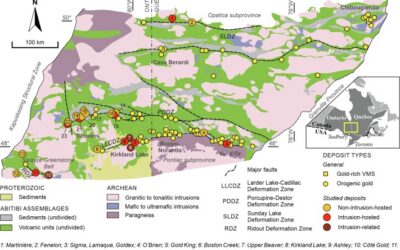
Mineral Exploration in the Abitibi Greenstone Belt: Geology, Deposit Types, and What to Expect in the Field
Image Source: https://www.sciencedirect.com/science/article/abs/pii/S016913682100247X The Abitibi Greenstone Belt produced more gold than almost any other Archean terrane on Earth, and the ground is still generating discovery-stage programs across northern Ontario and...
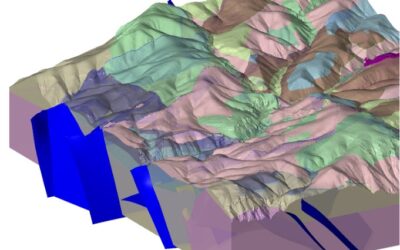
Beyond the Borehole: How 3D Geotechnical Modeling is De-Risking Modern Mine Design
The difference between a viable project and a costly oversight lies in the "digital twin" of the subsurface. Traditional 2D cross-sections, once the industry standard, are no longer sufficient for the complexities of modern resource extraction and the stringent safety...

Starting a Geology Career in Mining and Mineral Exploration
Graduating with a geology degree opens doors, but it can be hard to know which ones to walk through first. Many new graduates want work that's hands-on, technically meaningful, and connected to real projects, but translating that into an actual job search takes some...

Soil Sampling vs. Magnetic vs. Gravity Surveys in Canada’s Covered Terrain
Canada is home to some of the world’s most promising mineral districts, but many of those opportunities lie beneath cover rather than in clean, exposed outcrops. Across much of the country, exploration teams work in terrain shaped by glaciation, transported...

2026 Regulatory Shifts in Geophysics & Geotechnical Reporting in Canada
For Canadian junior and major exploration firms, the "Qualified Person" (QP) is under more scrutiny than ever. As we move into 2026, the integration of geophysical data into NI 43-101 technical reports has evolved from "supplemental" to "essential." In an era of...
How Geophysical Surveys Support Mineral Exploration in Canada’s Remote and Covered Terrains
Canada is one of the most mineral-rich countries in the world, but much of that potential lies in places that are difficult, expensive, or logistically complex to explore. From vast stretches of the Precambrian Shield to sediment-covered basins and northern regions...

Gravity Surveys in Mineral Exploration: How They Work, What They Reveal, and Why They Matter
In mineral exploration, every decision hinges on understanding what lies beneath the surface before drilling begins. Gravity surveys provide a precise, cost-effective way to map subsurface density variations and uncover geological structures that may host valuable...

Why Magnetic and Gravity Surveys Are Essential for Mineral Exploration in Canada
Canada is one of the most geophysically explored countries in the world. With vast mineral potential spread across the Precambrian Shield, structurally complex greenstone belts, sedimentary basins, and remote northern terrains, Canadian exploration has long relied on...